
Referrals don’t happen by chance – they’re built through relationships. Most agents lose out on referrals because they stop engaging with clients after closing a deal. Here’s the solution: a structured system to stay connected, provide value, and remain top-of-mind without being pushy.
Key Takeaways:
- 90% of agents stop communicating after a deal closes, leading to missed opportunities.
- A well-maintained database can generate deals equal to 10% of its total contacts annually.
- Regular touchpoints (quarterly calls, milestone reminders) and personalized updates drive referrals naturally.
- Segment your database (A+, A, B, C) to prioritize outreach effectively.
- Use tools like CRMs to track milestones, automate reminders, and keep data organized.
By focusing on consistent communication, offering helpful insights, and leveraging key milestones, you can turn your database into a reliable source of referrals – without resorting to awkward or salesy tactics.
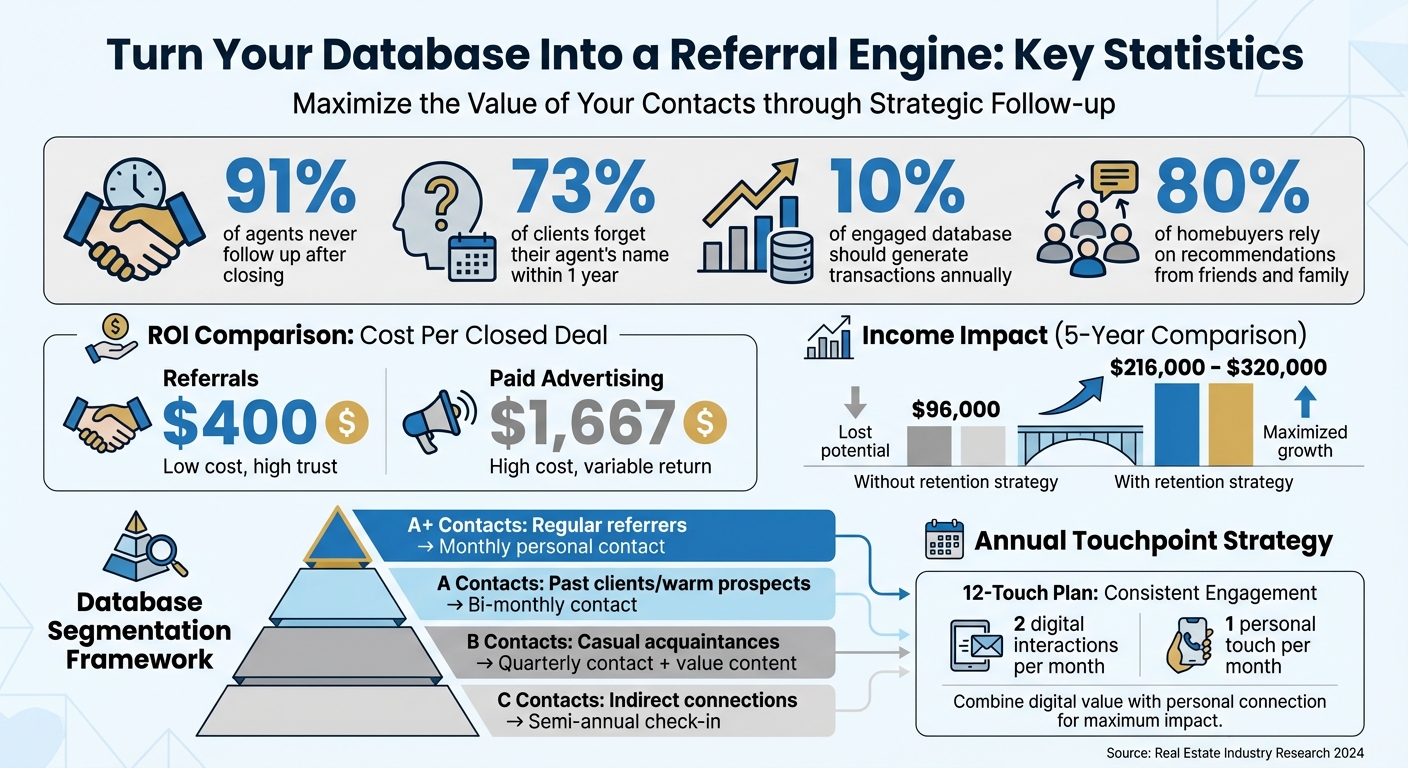
Real Estate Database Referral Statistics and ROI
Why Most Databases Don’t Generate Referrals
Common Database Problems
Most real estate agents collect contact information but fail to actually use it effectively. Here’s a staggering statistic: 91% of agents never follow up with their buyers or sellers after closing a deal [7]. This lack of communication leaves past clients feeling forgotten, even if they intended to work with you again in the future.
One of the biggest issues? Disorganized data scattered across multiple platforms. Without proper organization, agents struggle to segment their contacts, resulting in generic, one-size-fits-all emails. These impersonal messages lack relevance – like sending a mass email instead of a tailored update about a specific neighborhood. This approach reduces trust and turns what could have been a long-term relationship into a one-off transaction. And clients can sense when the only time they hear from you is when you’re looking for new business.
"Your database is the heart of your real estate business; your relationships are the blood that keeps it alive." – RealOffice360 [7]
Another common problem is the absence of structured follow-ups. Without tools like milestone reminders or anniversary notifications, your database becomes nothing more than a static list of names. When there’s no system to keep in touch, opportunities for referrals and repeat transactions are lost. Fixing these gaps can transform your database from a dormant resource into a steady source of income.
Why an Active Database Matters
When you actively nurture your database, it stops being just a collection of contacts and starts becoming a reliable revenue stream. The math is simple: at least 10% of an engaged database should generate a transaction each year through repeat business or referrals [1]. For example, if you have 100 well-nurtured contacts, you could expect 10 deals annually. That’s the power of consistent engagement.
This transformation requires a mindset shift. Stop viewing your database as a tool for one-time transactions and start treating it like a garden – it needs regular care to thrive [2][5]. Weekly updates help keep your information fresh, quarterly touchpoints build trust, and segmentation ensures you’re focusing on your most valuable relationships. With 80% of homebuyers relying on recommendations from friends and family to find an agent [5], staying top-of-mind is critical.
"A minimum of 10% of your database should be buying or selling with you every year, assuming that you speak with them regularly. It won’t happen if you only speak with your database when you’re starving for new business." – Tim and Julie Harris, Real Estate Coaches [1]
The Referral Loop Framework
5 Core Elements of the Referral Loop
A referral system thrives on a consistent, thoughtful cycle that keeps your business visible and relevant. This framework revolves around five interconnected elements, often referred to as a "referral engine."
First, visibility. Staying top-of-mind starts with regular communication. A great way to do this is through quarterly phone calls using the F.O.R.D. method (Family, Occupation, Recreation, Dreams), which ensures conversations feel personal, not transactional[6]. Add to this monthly market updates and a strong presence across various platforms to solidify your visibility.
Second, value delivery. Shift from simply providing a service to becoming a trusted advisor. Share hyper-local market insights, home valuation reports, and reliable vendor recommendations. This creates a sense of reciprocity – people are naturally inclined to help those who’ve provided them meaningful value.
Third, credibility reinforcement. Trust is key, and social proof helps build it. Use tools like video testimonials and success stories to showcase your expertise. When someone refers you, they’re already putting their trust in you. Reinforcing that trust with evidence of your market knowledge makes the referral process even smoother.
Fourth, memory triggers. Milestones like home anniversaries, birthdays, or even tax season are perfect opportunities to reconnect. These moments feel genuine and help you stay memorable, ensuring you’re the first name that comes to mind when real estate needs arise.
Fifth, easy introductions. Simplify the referral process with structured programs or easy-to-use digital tools that make it effortless for others to refer you.
When these five elements work together, they create a self-sustaining cycle. Providing consistent value builds trust, trust leads to organic referrals, and those referrals feed back into the cycle[3]. As Real Estate Magazine aptly put it:
"Referrals don’t ‘just happen.’ They are engineered."[3]
This structured strategy ensures you stay top-of-mind, driving ongoing engagement and referrals.
Why Top-of-Mind Positioning Works
By leveraging these core elements, you can turn routine interactions into a steady stream of referrals. For example, with a well-maintained database of 200 contacts, you could generate 20 deals annually – without cold calling or paid ads.
Here’s a startling fact: 73% of clients forget their agent’s name within a year if there’s no follow-up[4]. Without consistent engagement, every new lead becomes a reset in visibility.
Top-of-mind positioning ensures referrals come naturally by maintaining a steady, value-driven presence. When someone in your network hears a friend mention they’re thinking about moving, your name pops up effortlessly because you’ve remained helpful and relevant.
The goal is to shift from passive referrals – hoping someone remembers you – to intentional referrals, created through structured, meaningful touchpoints. This isn’t about being pushy; it’s about being present, helpful, and memorable when your expertise is needed most[3].
Building the Foundation: Clean and Structured Data
How to Segment and Organize Your Database
To turn your database into a referral powerhouse, you need structure. Start by categorizing your contacts based on their relationship strength and transaction timeline. Here’s a simple framework:
- A+ Contacts: These are your MVPs – clients who regularly refer business your way.
- A Contacts: Past clients and warm prospects likely to act within 6–12 months.
- B Contacts: Casual acquaintances or potential prospects with longer timelines.
- C Contacts: Indirect connections or early-stage leads.
This segmentation helps you prioritize your outreach. For example, A+ contacts might get monthly personal calls, while C contacts might only need a check-in twice a year.
Here’s a quick snapshot of how to manage communication:
| Category | Description | Communication Frequency |
|---|---|---|
| A+ Contacts | Regular referrers; close advocates | Monthly personal contact |
| A Contacts | Past clients and very warm prospects | Bi-monthly personal contact |
| B Contacts | Casual acquaintances and potential prospects | Quarterly contact + value content |
| C Contacts | Indirect connections; early-stage leads | Semi-annual check-in + value content |
High-performing agents often see a 10% annual return from their database. That means if your database has 100 names, you could generate 10 deals per year – provided your communication is consistent and well-organized [1].
To keep things running smoothly, standardize your data entry process to avoid duplicate contacts and ensure quick searches. Validate email addresses before importing them into your CRM to maintain high deliverability rates. And don’t forget to grow your database – aim to add at least five new contacts each week to keep your referral system thriving [1].
Tracking Milestones and Anniversaries
Your database isn’t just a list of names; it’s a treasure trove of opportunities for meaningful connections. Capture personal details like birthdays, family members, and property purchase dates. These small touches can transform your outreach from generic to memorable.
For instance, set up reminders for home purchase anniversaries or birthdays at least two weeks in advance. This gives you time to prepare a thoughtful gesture, like a handwritten card or a small gift [4]. During transactions, casually ask for birthdays – it’s a simple way to build a future touchpoint [4].
Why does this matter? A staggering 73% of clients forget their agent’s name within a year of closing [4]. Milestones give you a reason to stay on their radar in a way that feels genuine, not transactional.
Don’t stop at dates. Personal notes – like a pet’s name, a child’s graduation, or a planned vacation – can serve as future conversation starters. Referencing these details shows you’re paying attention and adds a layer of authenticity to your follow-ups [5][3].
Database Management Best Practices
An organized database is only as good as its upkeep. Regular audits are essential to ensure your contact details, tags, and interaction history stay accurate [1][5]. People change their phone numbers, email addresses, and even physical addresses more often than you think. Outdated information can derail your outreach efforts.
Identify the top 5% of your contacts who drive most of your referrals and move them into a VIP or A+ category. These are the people who deserve your highest level of attention and the most frequent, personalized touchpoints [3].
Tools like Real Estate 7’s integrated CRM can simplify the process by centralizing contact management, milestone tracking, and automated reminders. Keeping your data clean and up-to-date isn’t just a chore – it’s the backbone of a successful referral system. For more tips on structuring your database, check out the best practices for real estate contact databases.
Stop Asking for Referrals: The 4-Step System That Actually Works for Real Estate Agents – Video 4
Setting Up Quarterly Touchpoints
Quarterly touchpoints provide a structured way to stay connected with your network, keeping you in their thoughts without coming across as pushy.
Examples of Effective Touchpoints
Consistency is key when it comes to staying visible. A quarterly schedule strikes the perfect balance – frequent enough to maintain relevance, but spaced out enough to avoid overwhelming your contacts.
One great option is sending neighborhood-specific market updates. Instead of generic reports, craft a concise three-sentence email that highlights the local market trends, recent nearby sales, and the highest sale price in the area. This positions you as the go-to expert for local real estate insights.
Another idea is offering home equity snapshots. Many homeowners don’t realize how much equity their property has gained over time. Sharing a brief overview of appreciation trends can grab their attention without sounding like a sales pitch. You can also add seasonal home maintenance tips – like spring landscaping advice, summer energy-saving strategies, fall preparation for colder weather, or winter renovation ideas paired with market predictions. These thoughtful touches show you care about their home beyond the initial sale.
For your VIP contacts, consider scheduling annual home checkups. Use the opportunity to discuss home performance and offer tailored advice. When reaching out, try asking, “How is the home treating you?” instead of leading with, “Do you plan to move?” This subtle difference shifts the focus to the relationship rather than a transaction.
These touchpoints not only showcase your expertise but also help build a foundation of trust and long-term loyalty.
How Regular Value Builds Trust
By offering consistent, relevant updates, you reinforce your credibility and reliability. Showing up with genuinely helpful insights every 90 days, rather than a sales pitch, trains your network to associate you with real estate expertise. This is essential because 80% of home buyers rely on advice from friends and family when choosing an agent [5]. Yet, surprisingly, 73% of clients forget their agent’s name within a year of closing [4]. Quarterly touchpoints help you avoid becoming part of that statistic.
Regular, value-driven communication also encourages reciprocity. When you consistently provide useful information, your contacts are more likely to return the favor by recommending you. That’s why many top agents follow a “12-touch” annual strategy. This includes two digital interactions – like newsletters or updates – and one personal interaction, such as a call, text, or small gift, every month [4]. It’s a proven way to stay present in your network’s mind while maintaining a reputation as a trusted resource, not just another salesperson.
Sending Value-Driven Updates
How often and what you share plays a huge role in staying on someone’s radar. When you provide updates packed with value, you position yourself as a knowledgeable resource – not just someone who pops up when there’s business to discuss.
Types of Value-Based Communication
The best updates focus on things your audience genuinely cares about: their home and neighborhood. Insights tailored to local sales trends hit home because they’re personal and relevant. For example, you could share details about three recent sales on nearby streets, highlight the highest sale price in their zip code, and pair it with a quick market observation.
Talking about buyer demand trends in the neighborhood is another way to grab attention. A short message like, "Five buyers competed for a home on Oak Street last week", paints a clear picture of demand without coming across as pushy. Additionally, sharing updates on factors that impact property values – like improved school ratings, upcoming commercial projects, or new infrastructure – shows you’re tuned into what matters most to them.
This kind of targeted communication sets the stage for building trust and natural engagement.
How Value Creates Natural Reciprocity
When you consistently deliver meaningful updates, it naturally encourages people to engage with you. Sharing useful information positions you as the go-to expert, making it easy for them to turn to you when they need real estate advice – or when someone they know does. The key here is simple: give value before you ask for anything. When trust is established, asking for referrals feels effortless because the groundwork is already in place.
This strategy is especially important when you consider that 73% of clients forget their agent’s name within a year of closing [4]. Regular, value-packed updates combat this forgetfulness. Top agents who keep a structured communication plan in place often see at least 10% of their contacts buying or selling annually [1]. That’s not random – it’s the result of consistent, relevant updates every 90 days, strengthening trust with each interaction.
Using Milestone Triggers
Milestones offer a natural way to reconnect without making it feel like just another routine check-in. Reaching out for a home purchase anniversary or a birthday feels personal and thoughtful, giving the interaction a genuine touch. Incorporating these moments into your outreach plan ensures consistent and meaningful communication.
Automating Key Milestone Touchpoints
A CRM can be your best friend when it comes to managing key milestones. For example, a one-year home anniversary is often overlooked by agents, but acknowledging it can instantly set you apart[4][8]. Other impactful moments to mark include client birthdays and seasonal check-ins, like April 1st for spring preparations or September 1st for fall maintenance reminders[8].
Take it a step further by automating reminders for personal details. Did a client mention their kids? Schedule a note for back-to-school season. Did they talk about their dog? Record the pet’s name to reference in future conversations. These small but meaningful details can transform a simple reminder into a heartfelt connection. When done right, these efforts can lead to 10% of your database buying or selling with you annually[1].
With automated tools handling the logistics, you can focus on crafting messages that feel authentic and personal.
Making Milestone Messages Feel Personal
Automated reminders are just the starting point. To truly connect, your messages need to reflect warmth and specific memories. Avoid generic phrases and instead reference something unique to the client, like a standout feature of their home or a moment you shared during the transaction[2].
"The moment those papers are signed isn’t the end of your job; it’s just the beginning of the relationship." – CircleCloser[2]
Keep your tone friendly and avoid anything that feels overly promotional. A simple message like, "Hope you’re still enjoying that amazing backyard – happy one-year anniversary in your home!" feels thoughtful and genuine. For birthdays, a handwritten card paired with a small gift, like a $25 Starbucks card, can leave a lasting impression[4][8]. The key is to make clients feel remembered, not marketed to. When done well, milestone messages naturally reopen conversations and keep you top of mind without any awkwardness.
Building Credibility with Social Proof
Trust is the bedrock of referrals. Social proof helps reduce the perceived risk for anyone recommending you. When your network regularly sees evidence of your expertise and satisfied clients, they feel confident introducing you to people they care about. These strategies work hand-in-hand with your visibility efforts to create a steady stream of referrals.
Sharing Client Success Stories and Reviews
Testimonials are a powerful way to showcase positive client experiences. But not all testimonials are created equal – specific details make a huge difference. For instance, "John helped us find our dream home in Downtown Austin within our $450,000 budget and closed in just 22 days" feels far more relatable and trustworthy than a vague "Great agent!" [12].
"Relationship mitigates risk." – Robert Hughes, Executive Coach and CEO, Hughes Integrated [9]
When asking for testimonials, guide clients by framing their feedback around three key points: the challenge they faced, your solution, and the result. For example, a seller might share how you managed showings around their busy schedule, leading to a fast and seamless sale. Timing matters too – request testimonials right after closing, when satisfaction is at its peak. Use open-ended prompts like "What stood out most about working with me?" to encourage detailed responses [12].
Make sure these testimonials are easy to find. Feature them on your homepage, Google Business Profile, or in listing presentations. When clients see these stories, they’re reminded of the positive experiences others have had, making them more likely to refer you [11].
Demonstrating Your Market Activity
Client testimonials are just one piece of the puzzle. Highlighting your ongoing market activity can further reinforce your credibility. Sharing data – like average days on market, percentage of asking price achieved, or recent transaction totals – shows that you consistently deliver results [10].
Bring these numbers to life by pairing them with a client story or visual infographic. For instance, a quick "market update email" might include a brief summary of market trends, highlight three recent neighborhood sales, and mention the highest sale price in the area. This approach feels informative rather than promotional and can naturally spark conversations [3].
Being active in the local community also strengthens your reputation. Partnering with trusted local contractors or featuring neighborhood businesses in your newsletter positions you as a go-to resource. Considering that 80% of home buyers rely on advice from friends and family when choosing an agent [5], being seen as a local expert makes referrals effortless and low-risk.
Tracking and Improving Your Referral System
Measuring key metrics is essential to understanding whether your referral system is working or just keeping you busy. Without tracking, you’re left guessing. The right data shows you what’s working and where tweaks are needed to boost results.
Key Metrics to Monitor
Start by focusing on re-engagement conversations – how many past clients respond to your milestone messages or quarterly outreach. This figure tells you if your efforts are resonating or falling flat. Another critical metric is referral introductions per quarter. A steady number of introductions signals that your positioning is effective. Then there’s referral yield, which follows the "10% Rule." For example, if you have 200 contacts, you should expect around 20 deals per year [1].
Don’t overlook client retention rates. While 82% of clients say they’d work with their agent again, only 12% actually follow through – usually because the agent stopped staying in touch [4]. Even more striking, 73% of clients forget their agent’s name within a year of closing [4]. Consistent communication gives you a clear edge. Lastly, compare the cost per closed deal for referrals against other lead sources. Referrals typically cost about $400 per closed deal, compared to $1,667 for paid advertising leads [4].
Using Data to Optimize Performance
With your metrics in place, use them to refine your referral strategy. Organize your database into A, B, C, and A+ categories to prioritize outreach. For example:
- A+ contacts: Regular referrers who deserve monthly personal contact.
- A contacts: Past clients and warm prospects who should hear from you every other month.
- B contacts: Quarterly personal outreach plus consistent value-driven content.
- C contacts: Semi-annual check-ins [5].
This tiered approach ensures your time is spent where it delivers the best returns.
Keep your CRM up to date by logging every meaningful interaction. If a client shares a life milestone or asks for a vendor recommendation, record it [5][2]. These details make future touchpoints more personal and help identify referral opportunities. Also, make it a habit to validate contact information quarterly – outdated data weakens your outreach [5]. Clean, accurate records amplify every message you send.
If your referral numbers aren’t meeting expectations, take a closer look at your touchpoint strategy. Are you sending generic updates, or providing hyper-local insights that matter to your clients? Are milestone triggers being followed consistently, or are they slipping through the cracks? Even small changes – like reaching out to A-level clients every other month instead of quarterly – can significantly boost referrals without coming across as pushy.
Conclusion
A referral system that works well relies on value, timing, and trust – not on pushy tactics or uncomfortable requests. By keeping your database organized, maintaining regular quarterly check-ins, and using milestone triggers, you can encourage introductions naturally.
A properly managed database can yield a 10% conversion rate – about one deal for every ten contacts – despite the fact that 73% of clients forget their agent’s name within a year [1][4]. As mentioned earlier, relationships fade without consistent follow-up [4]. This highlights the importance of predictable, systematic engagement over sporadic outreach.
"The transaction ends. The relationship dies. That’s what happens to 90% of real estate agents… It’s not because you did a bad job. It’s because you disappeared." – The Perna Team [4]
The focus shouldn’t be on aggressive communication but on steady, structured engagement. A 12-touch annual plan, combining two digital interactions and one personal touch each month, keeps you top of mind without overwhelming your contacts [4]. When paired with accurate data, valuable updates, and social proof, such as reviews and testimonials, to bolster your credibility, your database evolves from a static list into a reliable referral engine. This method reinforces your role as a trusted advisor, ensuring the long-term relationships that fuel your referral system.
The financial impact speaks for itself: an agent earning $96,000 over five years versus one earning $216,000 to $320,000 from the same 12 clients often comes down to one thing – a consistent retention strategy [4]. Build a solid structure, provide ongoing value, and let your system work for you.
FAQs
What’s the ideal quarterly touchpoint schedule for maximizing referrals without overwhelming my database?
The best approach to quarterly touchpoints is to connect roughly every 90 days with updates that offer real value. Share tailored insights such as market trends, home equity updates, or seasonal maintenance tips. The goal is to provide information that’s both useful and relevant, helping to build trust while keeping your name in their mind.
While automation can help ensure consistency, it’s crucial to add a personal touch to maintain a genuine connection. Sticking to a quarterly schedule strikes the right balance – it nurtures relationships without making your communications feel excessive. Over time, this steady engagement can naturally lead to more referrals.
How do I balance automation with personalization in my referral system?
To strike a balance between automation and personalization, use automation to handle consistent touchpoints like milestone reminders, anniversary greetings, or updates that provide value. Then, add a personal touch by including client-specific details, such as information about their property or referencing past conversations. Simple but thoughtful gestures – like celebrating achievements or sharing customized market insights – can make these interactions feel more sincere. While automation can streamline routine tasks, always weave in personal elements to keep the connection authentic and build stronger relationships.
Which metric best predicts whether my referral system is strengthening over time?
The most effective way to measure the success of your referral system is by tracking the number of referral introductions per quarter. This metric provides a clear picture of how engaged your network is and how often organic referrals are happening. A steady or increasing number shows that your system is successfully fostering connections and maintaining visibility within your network.


