
Most real estate website visitors don’t fill out forms. They prefer browsing, researching neighborhoods, or analyzing trends without committing to sharing personal details. Traditional forms often feel intrusive and discourage engagement, leading to missed opportunities with potential leads. Instead of relying solely on forms, you can engage these “silent visitors” with tools and strategies that respect their pace and build trust over time.
Key Takeaways:
- Why forms fail: Forms create pressure by asking for too much information too soon, driving away 90% of visitors.
- Behavior to watch: Repeated property searches, value checks, and re-engagement after dormancy signal serious interest.
- Better alternatives: Use conversational tools, saved searches, soft CTAs, alerts, and interactive features to encourage natural engagement. These capabilities are standard in comprehensive real estate platforms designed for lead conversion.
How to Identify Silent Visitor Behavior
What Silent Visitors Do on Your Site
Silent visitors may not say much, but their actions leave a trail of clues. For instance, repeated checks of a property’s value often indicate serious interest. If someone revisits their home’s valuation multiple times over a short period, they’re likely weighing options like selling or refinancing. A great example of this comes from the Thompson Team in Seattle. In 2023, they introduced automated home value alerts for their database, which allowed them to track homeowners who frequently checked their property values. The result? A 327% increase in listing appointments within just 90 days [2].
Another revealing behavior is when visitors adjust their search criteria. For example, shifting from 3-bedroom homes to 4-bedroom ones or increasing their price range from $400,000 to $600,000 signals evolving priorities. A compelling case comes from Jenny Johnson, VP at Majestic/Sierra SIR. In 2024, she noticed a lead who initially viewed $3M–$5M homes but repeatedly clicked on $6M–$8M listings. Acting on this insight, she arranged a tour of higher-priced homes, which led to the clients making offers on $10M properties [2].
"With RealScout, I could see they’d only look at $3-5M once, but the ones $6-8M they’d click on many times. They came to visit and I put together a tour at higher prices due to these insights." – Jenny Johnson, VP, Majestic/Sierra SIR [2]
Another key signal is re-engagement after dormancy. When a previously inactive user revisits your site after months of silence, it often means they’re experiencing a major life change or renewed interest in the market. For example, in 2024, Joey Guest, Founder of Team Real Local at Real Broker, tracked a buyer who had been inactive in their CRM for eight months. Thanks to automated tracking, they identified the re-engaged buyer, leading to a signed contract in just six days [2].
These patterns show that silence doesn’t mean disinterest – it often reflects careful consideration and caution.
Why Silence Means Hesitation, Not Disinterest
The difference between hesitation and disinterest lies in what visitors do, not what they say. High-intent visitors often display specific behaviors, like repeatedly checking data such as home values or equity positions over short periods. They may also increase their browsing activity or refine their search criteria in ways that suggest serious intent. On the flip side, one-off searches or shallow engagement are more indicative of low interest.
Another key indicator of intent is the consumption of detailed resources, like selling guides or market reports. When visitors dive into this kind of content, it’s a sign they’re actively weighing their options and building confidence in their next steps. The challenge for agents is that 93% of past clients and sphere contacts end up listing with other agents [2]. Silent visitors are often ready to take action – they’re just waiting for the right timing and a thoughtful, non-pushy approach.
Recognizing these subtle signals is essential for creating engagement strategies that feel natural and effective.
Why Forms Don’t Work for Low-Intent Visitors
The Mental Barrier Forms Create
Forms ask for too much, too soon. Picture this: someone lands on your site just to browse a few listings or check out neighborhood prices. Suddenly, they’re hit with a form asking for their name, email, and phone number. It feels like jumping into a commitment they’re not ready for. Instead of a helpful browsing experience, it feels like the start of a sales pitch – and that triggers resistance.
The problem lies in the imbalance. Visitors are asked to hand over personal details before they’ve received anything of value. For someone casually exploring, this feels unfair. Why should they trust you with their contact information when they’re still deciding if they trust the market at all? Add privacy concerns to the mix – like fears of spam emails or their data being sold – and the hesitation only grows.
"Successful lead capture is about timing and context. When calls-to-action align with the user’s journey, they feel helpful – not disruptive." – Jaycie Mariotti, Director of Marketing, Sierra Interactive [3]
Even the simplest forms come with a “hassle factor.” Filling out fields feels like a chore, especially when all a visitor wants is to scroll through photos or read a quick market update. This mental friction is why forms often scare off low-commitment visitors before they’ve had a chance to engage.
How Forms Reduce Engagement and Conversions
The mental barriers forms create don’t just discourage interaction – they also hurt your bottom line. Numbers tell the story: traditional lead capture forms on real estate websites only gather contact information from 10% of visitors [4]. That means 90% of potential leads vanish without leaving a trace, often because the form shows up before trust has been built.
Forms also disrupt the natural flow of browsing. Imagine someone comparing properties or researching neighborhoods. A form popping up in the middle of their process acts like a roadblock, breaking their momentum and raising the stakes too soon. Many visitors abandon the site entirely, opting to continue their search elsewhere instead of dealing with the interruption.
Here’s the kicker: 82% of consumers prefer chatbots over filling out forms or waiting for a representative [4]. And when static forms are replaced with conversational tools, conversion rates can jump by 45%, while engagement rates triple [4][5]. The issue isn’t a lack of interest from visitors – it’s the rigid, transactional nature of forms. Low-intent visitors crave flexibility and the freedom to explore before they’re ready to share their information. To capture their attention (and their details), businesses need to rethink their marketing strategies and use methods that feel natural and non-intrusive.
Turn Website Visitors Into Leads Without Them Filling In A Form!
5 Methods to Capture Leads Without Forms
Generating leads doesn’t always require traditional forms. Instead, you can align with visitors’ natural behaviors using strategies that feel effortless and intuitive. These five methods focus on reducing barriers, respecting hesitation, and building trust over time.
Use Chat for Natural Conversations
Chat tools create a sense of ease because they feel like a choice, not a demand. Unlike forms that ask for information upfront, chat enables a back-and-forth exchange that mirrors real-life conversations. For example, a visitor might ask, "What’s the average price in this neighborhood?" or "Are there any homes with pools?" without worrying about being bombarded with follow-up sales calls.
Tools like ChatSpark take this further by providing 24/7 conversational AI. These tools answer questions instantly and keep visitors engaged. Because it feels like a genuine conversation rather than a transaction, visitors are more likely to stick around. And when they’re ready to share their contact details, it’s because they trust you – not because they felt forced.
Let Visitors Save Searches and Set Alerts
Sometimes, actions speak louder than words. Offering features like saved searches and alerts gives visitors real value while keeping them engaged. For instance, someone browsing three-bedroom homes in a specific neighborhood can save their search and receive updates when new listings match their criteria. Instead of handing over their email for no reason, they’re opting into something useful that keeps them coming back.
With tools like CT IDX Pro+, visitors can save searches, set alerts for price changes, and track new listings. This approach works because it aligns with how buyers naturally explore the market – they’re looking to monitor trends over time, not make a snap decision. By the time they reach out, they’re already familiar with your offerings and more likely to be serious about moving forward.
Add Soft CTAs That Match Browsing Intent
Once visitors start saving searches, you can gently nudge them forward with soft calls-to-action (CTAs). Instead of pushing for a consultation or pre-qualification, use phrases like "See similar homes", "Track this market", or "Compare nearby listings." These CTAs feel more like helpful suggestions than hard sells.
Soft CTAs guide visitors toward the next step without overwhelming them. For example, clicking "Get updates for this area" allows them to show interest without committing to a phone call. This approach respects their pace and captures their intent naturally.
Offer Interactive Tools That Encourage Exploration
Interactive tools are a great way to engage visitors without overwhelming them. They create small, exploratory steps – also called micro-commitments – that provide value while gathering insights. For example, a quiz asking "What’s your ideal home style?" or a pricing tool calculating monthly payments offers immediate benefits while helping you understand the visitor’s needs.
A tool like CT Automated Home Valuations is a fantastic example. Visitors can enter their address to get an estimated property value – something they genuinely want – and in return, you collect their contact details and property information on a high-converting landing page. This exchange feels fair and non-intrusive, creating a foundation for future interactions while educating visitors about their options.
Build Engagement Across Multiple Visits
Not every visitor will convert during their first visit, and that’s okay. Progressive engagement focuses on guiding visitors through a journey – from casual browsing to personalized interactions – over several sessions.
Features like chat memory, saved activity tracking, and return-visit recognition can help create a seamless experience. For instance, if a visitor comes back and sees their saved searches or resumes a previous chat conversation, they’ll feel like you’ve been paying attention. This sense of continuity fosters trust and familiarity, making it easier for them to move from passive browsing to active engagement when they’re ready.
How to Track Success Without Form Submissions
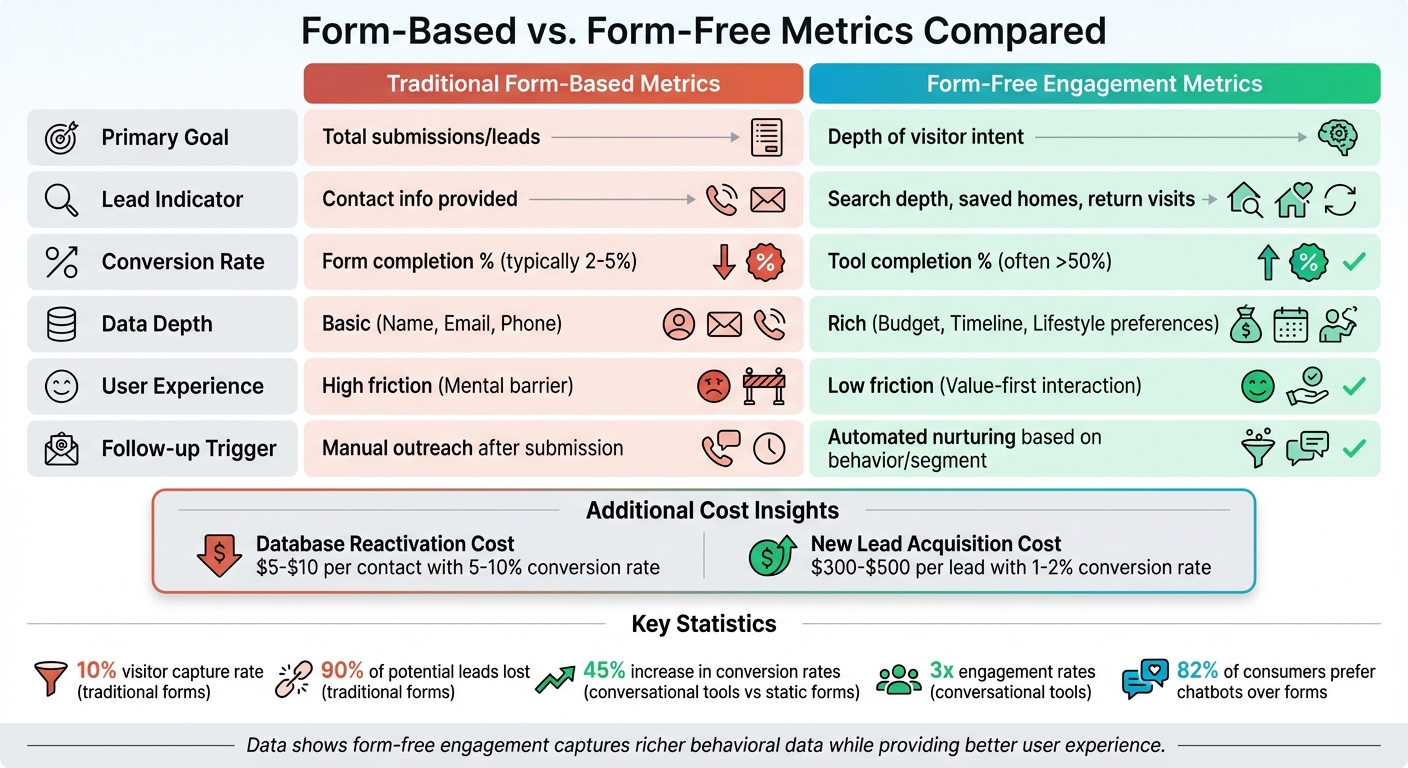
Form-Based vs Form-Free Lead Capture Metrics Comparison for Real Estate Websites
If you’re not relying on forms to capture leads, it’s time to focus on key behavioral signals that reveal genuine intent. These signals can show you who’s serious about buying or selling – even if they haven’t explicitly reached out. In this case, the depth of engagement often tells a much richer story than a single form submission.
Which Behaviors to Track Instead
To truly understand visitor intent, pay attention to these critical behaviors:
Search depth is a powerful indicator of buyer interest. When someone spends time viewing multiple properties in a specific area or frequently adjusts their search criteria, they’re showing a clear intent to buy. For example, in 2025, Jason Wright of Coldwell Banker used RealScout to monitor such patterns. Within just 48 hours, the platform identified high-intent activity, leading to a listing appointment for a $3 million property [2].
Property value checks are just as telling, especially for potential sellers. If a homeowner checks their property’s value multiple times in a short period, it’s often a sign they’re preparing to list. The Thompson Team in Seattle saw this firsthand in 2025 when they started using automated home value alerts. By tracking homeowners repeatedly checking their property values, they achieved a 327% increase in listing appointments within 90 days [2].
Return visits after dormancy are another major clue. If someone who’s been inactive for months suddenly re-engages, it’s worth investigating. Joey Guest, Founder of Team Real Local, demonstrated this in 2025 when his CRM flagged a buyer who had been dormant for eight months. After reaching out, the team had the buyer under contract in just six days [2]. This is significant when you consider that 93% of past clients and sphere contacts end up listing with other agents due to inconsistent follow-up [2].
Content consumption patterns also provide valuable insight. When a visitor repeatedly views evergreen content for real estate like "preparing to sell" guides or neighborhood reports, they’re signaling where they are in their decision-making process. Tracking these patterns allows for more personalized and timely follow-up.
Form-Based vs. Form-Free Metrics Compared
Traditional lead tracking often hinges on form completions, but form-free engagement metrics can provide a more nuanced view of visitor intent. Here’s how the two approaches compare:
| Metric Category | Traditional Form-Based Metrics | Form-Free Engagement Metrics |
|---|---|---|
| Primary Goal | Total submissions/leads | Depth of visitor intent |
| Lead Indicator | Contact info provided | Search depth, saved homes, return visits |
| Conversion Rate | Form completion % (typically 2-5%) | Tool completion % (often >50%) |
| Data Depth | Basic (Name, Email, Phone) | Rich (Budget, Timeline, Lifestyle preferences) |
| User Experience | High friction (Mental barrier) | Low friction (Value-first interaction) |
| Follow-up Trigger | Manual outreach after submission | Automated nurturing based on behavior/segment |
The differences are striking. While traditional forms often see low completion rates (2-5%), interactive tools frequently achieve completion rates above 50%. Plus, form-free tracking captures richer data – like budget, timeline, and lifestyle preferences – which makes follow-up conversations far more productive.
Reactivating your database through behavioral tracking is also cost-effective. It typically costs just $5-$10 per contact with a 5-10% conversion rate, compared to acquiring new leads, which can cost $300-$500 each with only a 1-2% conversion rate [2]. By focusing on silent visitor behavior, you can achieve a much better ROI while building stronger connections with high-intent prospects.
How to Design for Conversion Without Hurting UX
Creating a design that encourages conversions without compromising user experience (UX) is all about striking the right balance. The idea is to engage visitors in a way that feels natural and optional, allowing them to explore without feeling pressured or interrupted. This balance is what sets successful websites apart from those that leave users frustrated and disengaged.
UX Mistakes to Avoid
Overly restrictive content can be a major turn-off for visitors, often leading to high bounce rates and missed opportunities [1]. Imagine landing on a site and being immediately hit with a registration wall or forced popup – chances are, you’d leave just as quickly as you arrived. First impressions matter, and interrupting users in those crucial initial moments can drive them away.
Another common pitfall is blocking access to essential information. For example, gating all property or market details can frustrate users. A smarter approach? Let visitors explore a few listings – perhaps three or four – before prompting them for contact details [1]. This way, they have a chance to see the value your site offers before you ask for anything in return.
And then there are full-screen popups. While they might seem like a quick way to capture leads, they often create unnecessary friction and erode trust. These popups send a clear message: you’re more interested in collecting data than in providing a helpful experience.
Avoiding these missteps ensures your design remains user-friendly while supporting the low-friction strategies covered earlier.
Design Principles for Form-Free Lead Capture
Now that we’ve covered what not to do, let’s focus on design principles that encourage engagement naturally – without relying on intrusive forms or tactics.
The cornerstone of effective form-free design is optional engagement. Every interaction – whether it’s starting a chat, saving a search, or signing up for alerts – should feel like a choice, not an obligation. When visitors can browse freely without committing, they’re more likely to engage when they’re ready.
Clear navigation is another critical element. When users can easily find their way around your site, it reduces confusion and builds trust. Intuitive navigation ensures visitors always know their options, making their experience smoother and more enjoyable.
Finally, it’s essential to align with visitor intent. If someone is casually browsing neighborhoods, hitting them with a "Schedule a showing" call-to-action (CTA) feels out of place. Instead, offer something that matches their current mindset, like "See similar homes" or "Track this market." These softer CTAs and interactive tools, as discussed earlier, feel more natural and encourage engagement without being pushy.
The secret lies in giving visitors control over their experience. Meanwhile, you can quietly gather valuable data – such as their search patterns and saved properties, and repeat visits. This approach respects their autonomy while equipping you with the insights needed to follow up effectively and at the right time.
Conclusion
Many website visitors skip filling out forms – not because they’re uninterested, but because traditional forms demand too much information before trust has been established.
This is where form-free methods come into play. By adopting these techniques, you meet visitors on their terms, using low-pressure strategies that gather essential insights without disrupting their experience.
The benefits go far beyond simply collecting more leads. When calls-to-action fit seamlessly into the user’s journey, they come across as helpful rather than intrusive. This approach naturally attracts higher-quality prospects. By the time a visitor takes a step like saving a search or starting a chat, you already have valuable context – such as their preferences, timeline, and level of interest. This is far more meaningful than just a name and email address.
The outcome? Conversations that feel more natural, leads that are better qualified, and conversion rates that improve – all without creating a pushy atmosphere. By replacing traditional forms with user-focused engagement, you’re not just generating leads – you’re building trust step by step. These methods turn hesitation into confidence and engagement into measurable results.
FAQs
How can I understand and track the behavior of website visitors who don’t fill out forms?
Tracking silent visitors on your website comes down to observing their behavior and interactions. Pay attention to actions like browsing multiple property listings, refining search criteria, reading additional content, comparing different options, saving searches or homes, and making repeat visits. These subtle patterns can reveal genuine interest, even if the visitor hasn’t filled out a form or shared their details.
With the help of website analytics tools, you can dive deeper into metrics like how many pages they view, the time spent on each page, and how often they return. These data points can uncover potential leads and gauge their level of interest. By focusing on these behavioral cues, real estate professionals can better prioritize follow-ups and gain a clearer picture of what visitors are looking for – all without interrupting their browsing experience.
Why are chat tools better than traditional forms for capturing leads?
Chat tools provide a friendly and interactive way to connect with visitors, standing out from the more rigid feel of traditional forms. They come across as casual and low-pressure, giving users the freedom to ask quick questions or explore their options without any sense of obligation. This relaxed interaction lowers barriers and makes visitors feel at ease, paving the way for meaningful engagement over time.
Unlike static forms that can feel pushy or out of place, chat tools adjust to what the visitor needs in the moment. They offer a tailored experience that aligns with the user’s browsing habits, making it easier to understand their intent without disrupting their flow. This approach not only fosters trust but also leads to more meaningful conversations and better lead conversion rates.
How do soft CTAs improve user engagement on real estate websites?
Soft CTAs are a smart way to boost user engagement because they align seamlessly with how people naturally browse. Phrases like "See similar homes" or "Track this market" feel inviting rather than pushy, offering users a sense of control over their journey. By lowering the pressure and catering to what the visitor is already looking for, these subtle prompts encourage interaction and build trust. The result? A smoother experience that nudges users toward conversion without feeling disruptive.


