
Here’s the short answer: SEO Growth Engine can help your real estate site get found and understood more easily, but it cannot promise rankings, indexation, traffic, AI citations, or leads.
If I strip it down, the article says four things:
- Google and AI tools need crawlable pages
- Site structure, internal links, schema, and sitemaps help discovery
- Pages should match live MLS inventory and clear search intent
- Human review still matters, especially for AI-written market reports
That’s the core idea.
If your page is hard to crawl, thin, duplicate, or built for searches no one makes, it may do little work. If your page is clear, linked well, tied to live listings, and written around a specific local need, it has a better chance to be understood by search systems.
A few points stand out:
- Google treats crawling, indexing, and ranking as separate steps
- Mobile performance still matters because most real estate traffic comes from phones
- Schema and XML sitemaps help with discovery, not guaranteed rankings
- AI tools like ChatGPT, Gemini, and Perplexity may use public web pages, but they choose what to cite on their own
- AI market reports should be checked for dates, pricing data, inventory counts, tone, and fair housing issues before publishing
What this means for you: publish fewer pages, make them specific, connect them well, and track results in Google Search Console instead of judging success by page count alone.
Gemini SEO for Realtors: Why You’re Invisible and How to Rank
Quick take
| Topic | What the article says |
|---|---|
| Rankings | No guarantees |
| Google visibility | Helped by crawlable structure and page clarity |
| AI search visibility | May improve when pages are public, readable, and specific |
| Best page types | Long-tail local pages with live inventory |
| Weak page types | Empty, duplicate, or city-swap pages |
| AI content | Draft first, human check before publishing |
| Success metrics | Indexed pages, impressions, visits, engagement, leads |
In plain English: the tool helps remove site-level problems that can keep your content from being read well. It does not control what Google ranks or what AI systems mention.
That’s the lens I’d use for the rest of the article.
How Google and AI Search Find Real Estate Pages
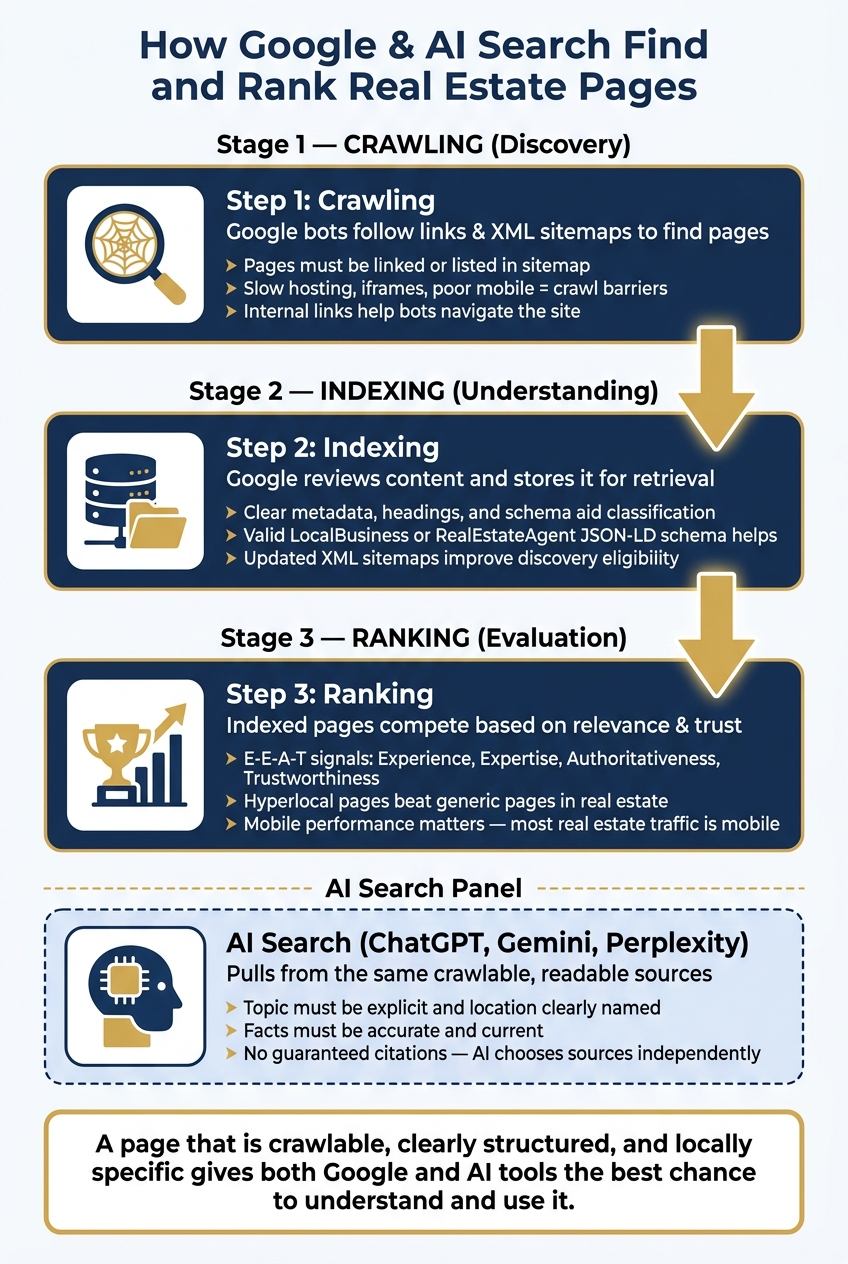
How Google & AI Search Find and Rank Real Estate Pages
Google and AI search tools find real estate pages through crawlable links, readable content, and clear structure.
Google Crawling, Indexing, and Ranking Are Three Separate Steps
Google doesn’t discover, understand, and rank a page all at once. These are separate steps. That matters because a page can be crawled but not indexed, or indexed but not rank.
Crawling is discovery. Google’s bots follow links and XML sitemaps to find pages. If your city page, neighborhood collection, or listing detail page isn’t linked from anywhere and isn’t in your sitemap, Google may never find it. Slow hosting, iframe-heavy pages, and poor mobile usability can also get in the way.
Indexing is understanding. After Google finds a page, it reviews the content and stores it. Clear metadata, headings, and valid schema make it easier for Google to classify the page. A page with a clear topic and solid structure is easier to sort than one with vague copy.
Ranking is evaluation. Indexed pages then compete for position based on relevance, authority, and trust signals like E-E-A-T – Experience, Expertise, Authoritativeness, and Trustworthiness. In real estate, hyperlocal pages that answer specific buyer and seller questions often beat generic pages.
AI-Assisted Search Pulls From Crawlable, Readable Sources
That same setup also helps AI tools read and summarize your pages. AI-assisted search tools pull from public pages that are easy to crawl and parse. If your pages aren’t crawlable, they’re less likely to be used as sources.
These systems tend to work best with clear, easy-to-read information. The topic should be obvious. The location should be named. The facts should stay consistent. In plain English, a page that says what it’s about usually has a better shot than one buried under salesy copy.
The same signals that help Google understand a page also help AI tools pull meaning from it. A neighborhood page that answers a question directly in plain prose is more useful than one that hides the answer inside marketing language.
Platform behavior changes a lot, and there isn’t a dependable formula for getting cited in a given AI answer. What you can do is remove friction:
- Keep pages crawlable
- Make topics explicit
- Name entities clearly
- Keep facts accurate and current
The next section shows how SEO Growth Engine applies these basics across WordPress real estate pages.
How SEO Growth Engine Builds a Search-Ready Real Estate Site
SEO Growth Engine works inside WordPress to give real estate pages a cleaner structure for both visitors and search systems. After that, the focus shifts to how that structure turns into actual pages, internal links, and technical signals.
Search-Focused Page Coverage Backed by Live MLS Inventory
The system should publish pages only for keyword and inventory combinations that show clear search intent and live MLS supply. A page for “homes under $600,000 in Scottsdale” makes sense only when active listings support it and people have a clear reason to look for it. Without that, the page is just filler.
This also opens the door to more precise collection pages. For example, pages built around narrow combinations like properties with EV charging stations can match buyer intent in a way broad city pages often don’t. That kind of specificity can line up much better with how people search when they know what they want.
From there, internal links and sitemaps help search systems move through the site.
Internal Linking, Schema, and XML Sitemaps
Broad hub pages should link down to narrower collection pages. Those collection pages should link back up and across to related content. That setup gives search systems a clearer picture of how pages connect and which topics belong together.
Valid schema markup also helps. Using LocalBusiness or RealEstateAgent in JSON-LD format tells search systems what a page is about without making them figure it out from body copy alone.
Updated XML sitemaps add another layer. They help crawlers find generated pages, including pages for narrow ZIP codes or price bands that may not be easy to reach through internal links alone.
Schema and sitemaps improve discovery eligibility, not indexing, rich results, or rankings.
WordPress Presentation and Technical Usability
Once a page can be found, presentation still matters. Real Estate 7 templates and CT IDX Pro+ widgets keep new collection pages aligned with the rest of your site. That consistency helps build trust with visitors and gives search systems cleaner structural cues.
That said, design alone won’t carry the page. It still needs to load fast, render the right way, work well on mobile, and cover basic accessibility needs. Canonical tags and indexation controls also need regular review so duplicate content doesn’t weaken the pages you want indexed.
How the Same Site Foundation May Support AI Search Discoverability
The same structure that helps Google crawl and index real estate pages can also make those pages easier for AI systems to read and interpret. AI-assisted search works best with sources that are crawlable and easy to read, where the topic, location, and page purpose are clear right away. For real estate sites, that matters most when pages tie together locations, property types, and live inventory.
Clear Topics, Named Entities, and Connected Market Context
A page titled "3-Bedroom Homes Under $500,000 in Tempe, AZ" cuts down on ambiguity fast. The topic is clear. The location is clear. The page intent is clear.
When a city hub links to neighborhood pages, price ranges, and property-type collections, the site feels like an organized market guide instead of a pile of isolated URLs. That kind of structure helps machines read the relationships between pages more easily. Still, no site structure can promise a citation or mention in an AI-generated response.
That same clarity matters for market reports too, and those reports need review before they go live.
The Required AI Workflow for Market-Report Content
SEO Growth Engine uses AI to draft market reports within the same workflow as page architecture, live MLS collections, internal links, schema, and XML sitemaps. But those reports should always be reviewed by a human before publication.
A draft is only the starting point. Before anything is published, someone needs to check dates, inventory figures, median price data, methodology references, tone, and fair housing compliance.
AI drafts help only when the final report is accurate, useful, clearly structured, and compliant.
How to Use SEO Growth Engine Responsibly and Track Results
That foundation only matters if you publish with restraint and track what it leads to.
Publish Useful Long-Tail Pages, Not Every Possible URL
Publish pages only when there’s clear search intent and live inventory to support them. Pages like “3-bedroom homes under $400,000” or “waterfront condos in a specific ZIP code” can work because they line up with a specific buyer need. Skip pages built around near-empty inventory, no local knowledge, or a simple city-name swap.
| Page Type | Publish When… | Skip If… |
|---|---|---|
| Location | You serve that neighborhood or ZIP code | No physical presence or local expertise |
| Property Type | Niche inventory exists, such as waterfront, luxury, or multi-gen homes | Generic category with no useful filters |
| Price + Bedrooms | Listings actually populate the page | The result is zero or near-zero listings |
| Intent-Based | Content answers a real buyer question with facts | The page is mostly marketing copy |
Use canonical tags and indexation controls to keep weak duplicate pages out of the index.
Publishing less – but publishing with purpose – is only one part of the picture. Trust and page performance still shape whether those URLs do any work.
What SEO Growth Engine Does Not Replace
SEO Growth Engine gives you a structured content base. It does not build your reputation for you. Local knowledge, first-hand market commentary, and real agent credentials still matter more than generated text by itself. Trust signals across your website, Google Business Profile, and other platforms are still on you.
Most real estate traffic comes from mobile devices, so slow or broken pages tend to fall flat. Conversion design, fast lead follow-up, and regular compliance review also sit outside the product’s scope.
Once that base is live, the next step is simple: measure discovery and track SEO conversions with the same discipline you used when deciding what to publish.
Conclusion: Measure Discovery With Realistic Expectations
SEO Growth Engine can improve discoverability foundations, but it does not guarantee outcomes. Track discovery signals, not raw page count.
Focus on signals like:
- Crawled and indexed pages in Google Search Console
- Search impressions across a broader set of queries
- Qualified organic visits
- Landing-page engagement
- Listing interactions
- Lead conversions
For AI discoverability, treat referral traffic from identifiable AI platforms as a directional signal, not proof of guaranteed visibility.
Use occasional manual prompts as a directional check, not proof of visibility.
FAQs
Can SEO Growth Engine guarantee Google rankings?
No. No software can guarantee Google rankings, inclusion in AI-generated answers, or traffic.
SEO Growth Engine helps improve how easy your pages are to find by making real estate content clearer, more useful, and easier to move through. That includes organized local pages, accurate listing data, structured schema, and content that’s easier for search engines and AI systems to understand.
Can it guarantee citations in AI answers?
No. SEO Growth Engine helps build structured, discoverable content, but it can’t promise rankings, citations, or lead generation.
It helps make property pages clearer and easier to find by using location pages, property-type pages, internal linking, live MLS data, schema, sitemaps, and consistent branding.
Does schema make a page rank or appear in AI search?
No. Schema can help search engines and AI systems understand your content more clearly, but it does not guarantee rankings, indexing, or citations.
SEO Growth Engine supports clearer visibility with locally focused pages, a crawlable site structure, internal linking, live listing data, and accurate business information. FAQs and structured data can help make content clearer, but they are not a direct ticket into Google or AI answers.
Is AI-generated content automatically better for AI search?
No. AI-generated content is not automatically better for AI search.
What matters more is clear, factual, machine-readable content and steady local and business context. CT IDX Pro+ SEO Growth Engine helps support that with crawlable pages, structured data, XML sitemaps, clear location hierarchies, and locally specific content pulled from live inventory.
That said, it cannot guarantee rankings, indexing, citations, or traffic.
How does internal linking help page discovery?
Internal linking helps search engines and AI systems find, crawl, and make sense of related pages. It also gives users a clearer path from broad topics to more specific ones.
In SEO Growth Engine, automated internal linking ties targeted pages, live MLS data, structured data, and sitemaps into a clearer site hierarchy. That can help visibility, but it does not guarantee rankings, AI-answer inclusion, or traffic.
Why does live MLS data matter?
Live MLS data makes location and property pages more useful for real estate shoppers because the information stays current. It also gives those pages clearer, machine-readable content that Google and AI systems may be able to understand and retrieve.
That said, it does not guarantee rankings, indexing, AI citations, or traffic.
Why is AI required, and does it automatically improve visibility in AI search?
AI is part of the process because SEO Growth Engine uses it in the workflow. But let’s be clear: no software can promise rankings, indexation, or placement in AI-generated answers or citations.
What SEO Growth Engine can do is help you build a site that’s clean and easy to follow. That includes location-based pages, internal linking, schema, and live MLS data. In plain English, it helps organize your content in a way search engines and AI systems can read more easily.
That said, visibility still comes down to a few big factors: authority, clarity, consistency, and useful local expertise.
How should AI-search visibility be measured?
Measure AI-search visibility through directional signals, not promises. Look at referral traffic from AI platforms you can identify, manually checked citations or mentions, and assisted conversions or shifts in branded search when attribution is available.
SEO Growth Engine may help with discoverability by using clear, machine-readable pages, internal links, live inventory, XML sitemaps, and structured data. But it does not guarantee rankings, indexing, or AI citations.


