
Automated real estate SEO can lower page-production cost and expand search coverage, but ROI only counts if it leads to closed deals or clear labor savings. More pages alone do not mean more money.
Here’s the short version:
- I would measure ROI with net commission from organic-attributed closings
- I would track three layers: visibility, lead flow, and profit
- Manual SEO can cost about $4,200/month for agency help and up to $10,000/month with a manual setup
- Automation can cut page-build and maintenance time, but it adds AI review, fact-checking, and compliance work
- ROI usually needs 6 to 12 months of data before the picture is clear
- Without CRM attribution, you can’t prove return
- Weak pages, thin templates, and bad follow-up can wipe out the upside
A simple way to think about it: if automation helps you publish more useful pages at a lower cost and those pages help produce qualified leads that turn into closings, the math can work. If not, it’s just cheaper page output.
| What I’d check first | Why it matters |
|---|---|
| Cost to build and maintain pages | Shows whether automation cuts labor |
| Indexation rate | Shows whether search engines use the pages |
| Qualified organic leads | Shows whether traffic has business value |
| Closed deals and net commission | Shows actual return |
| Review and compliance time | Shows hidden labor cost |
So the core question is simple: does automated SEO produce more profit than it costs? That’s the lens I’d use for the rest of this article.
How to Track SEO ROI in 5 Minutes (I Tracked $1,597,828.33 Easily)
Why Manual Real Estate SEO Gets Expensive Fast
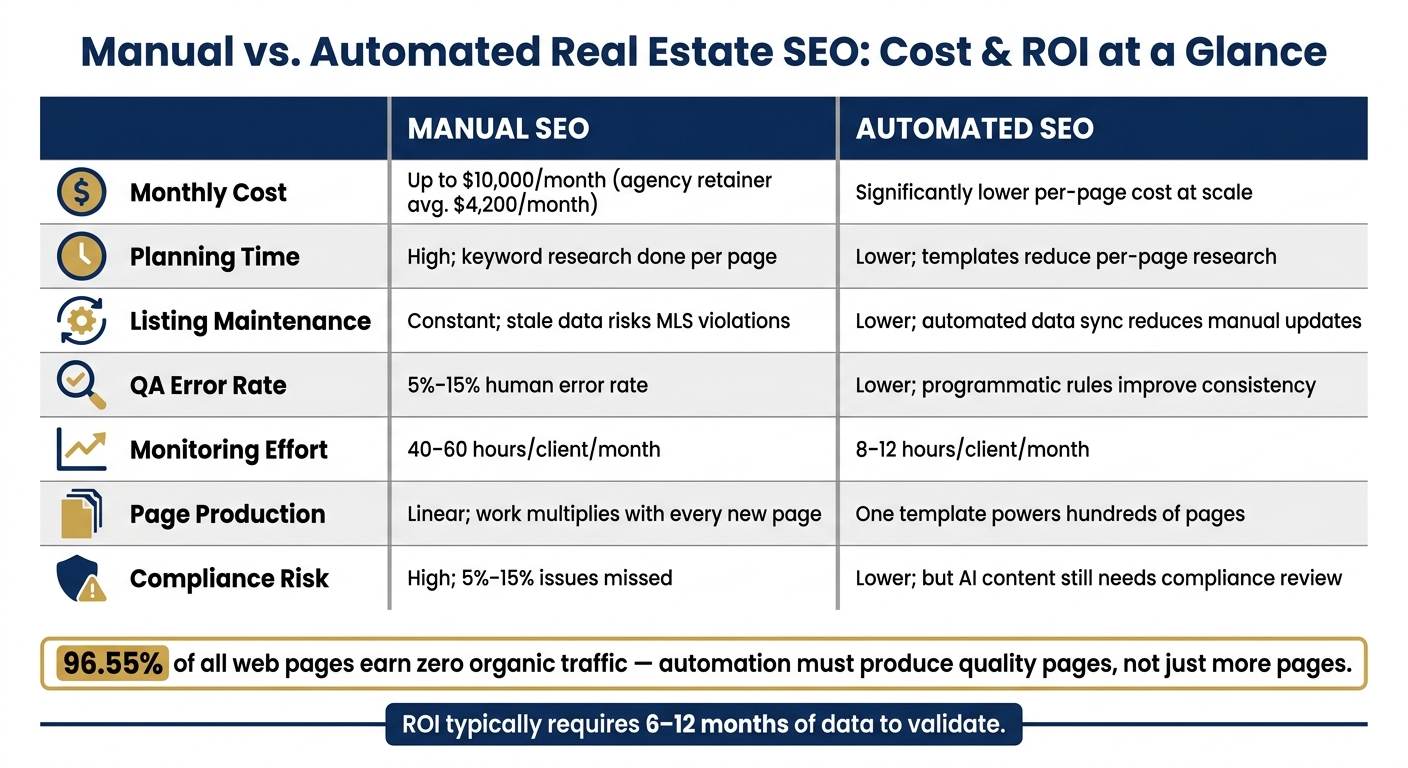
Manual vs. Automated Real Estate SEO: Cost & ROI Comparison
The Full Cost Stack of Manual SEO
Manual real estate SEO gets pricey fast because the work stacks up at every stage.
Before a page even goes live, someone has to handle strategy, page mapping, writing, publication prep, and compliance review. That means time is spent long before the page has any shot at bringing in traffic or leads.
Then the page launches, and the work still doesn’t stop. Real estate listings have short lifecycles, so teams have to keep updating pages to make sure the information stays current and MLS-compliant.
The staffing side makes things worse. Once you add employee time, freelance writers, agency retainers averaging around $4,200 per month [4], and SEO and marketing tool stacks, total ownership costs climb in a hurry. For a small agency using manual workflows, monthly costs can hit $10,000 [2].
That gap in cost is exactly what automated page systems aim to cut down.
Opportunity Cost and Low-Quality Scale
Slow production doesn’t just drain budget. It also hands over market coverage to other sites.
If a team can only publish a small number of pages each year, whole neighborhoods, school districts, and property-type combinations never get covered. And if your pages don’t exist, someone else gets that traffic.
Trying to fix the problem by pushing out more manual pages without tight controls can go sideways. Fast. Pages often end up thin, repetitive, or factually stale. And the web is already crowded with pages that go nowhere: 96.55% of all web pages studied earn zero organic traffic [3].
Real estate pages are even more exposed when they don’t include local details that make them worth reading. On top of that, there is the compliance risk. Phrases that may sound harmless, like "great for families" or "ideal for couples", can trigger Fair Housing Act violations under 24 CFR 100.75 [5]. Manual review also misses 5% to 15% of issues [2]. So cleanup work and compliance review don’t stay abstract – they become direct budget items.
Manual vs. Automated Cost Drivers: A Side-by-Side Look
The table shows where costs start to split.
| Cost Driver | Manual SEO | Automated SEO |
|---|---|---|
| Planning time | High; keyword research done per page | Lower; systems and templates reduce per-page research |
| Listing maintenance | Constant; stale data risks MLS violations [5] | Lower; automated data sync reduces manual updates |
| Technical setup | Linear; work multiplies with every new page | One template powers many pages |
| QA complexity | High; 5% to 15% human error rate [2] | Lower; programmatic rules improve consistency |
| Monitoring effort | 40 to 60 hours per client per month [2] | 8 to 12 hours per client per month [2] |
Across every row, the same thing keeps showing up: manual costs rise with volume, while automation cuts the labor added with each new page. That’s the shift that changes the math behind page production.
How Automated SEO Changes Page Production Economics
Reusable Page Systems and Live MLS Data
Automation changes ROI in a pretty simple way: it cuts the cost of each extra page, not just the first one.
With CT IDX Pro+, structured location data, property details, and preset rules take the place of the slow, repetitive job of building every city, ZIP code, neighborhood, or property-type page by hand. That means a small brokerage can publish hundreds of location and property pages without making each one manually.
Live MLS data through the RESO Web API keeps listing inventory current without manual republishing. So instead of rebuilding pages every time inventory shifts, the system keeps pace on its own.
Once page creation becomes reusable, the next place you save money is structure and design.
Automated Architecture and Centralized Design
Content is only part of the workload. At scale, the structural side of SEO often gets messy fast.
The SEO Growth Engine handles site structure that can slip when teams try to manage lots of pages by hand. Internal links matter because search engines rarely find isolated pages on their own. Schema markup and XML sitemap support are built into the system instead of being managed one page at a time, so centralized architecture cuts repeated setup work across the full page set.
With Real Estate 7, Elementor templates and WordPress widgets let you control the visual layout of city, price-range, and property-type pages through reusable components. Change one template, and the full page set updates with it. That cuts down on repeat edits, which is a big deal once you start dealing with dozens or hundreds of pages.
AI Content in the SEO Growth Engine Adds Review Work
Content automation shifts the cost stack again because fast draft production creates a new job: review.
The SEO Growth Engine requires AI, including for market-report content. It can speed up first drafts, but that does not equal net savings unless editing, fact-checking, and compliance time are part of the math.
Every AI-generated page still needs work for:
- brand voice
- fact-checking against current local data
- a compliance pass for Fair Housing Act language under 24 CFR 100.75
Phrases such as "great family neighborhood" can trigger violations regardless of intent [5]. Thin automated city pages may also need added detail or noindex treatment before publication.
That review cost belongs inside the ROI model, not somewhere off to the side.
How to Measure ROI: Investment, Return, Attribution, and Scenarios
Once review labor enters the picture, ROI stops being a simple traffic story. It becomes a question of cost, return, and payback.
Define the Investment and the Return
Total investment includes software fees, setup, configuration, design, taxonomy mapping, copy and template work, QA, compliance review, and ongoing optimization.
Return shows up in five layers, but only two hit cash directly.
- Production efficiency measures verified labor hours saved on repeat page setup using a WordPress IDX plugin.
- Search coverage looks at growth in useful landing pages, query diversity, and qualified impressions.
- Visitor engagement tracks listing views, saved searches, return visits, and contact-path activity.
- Lead and pipeline contribution ties organic landing pages to qualified leads, appointments, opportunities, and closed transactions.
- Strategic asset value is the organized site structure, but it should stay qualitative unless you can attach a dollar figure you can defend.
| Input | What It Represents | Likely Data Source |
|---|---|---|
| Total Investment | Software fees, setup, design, QA, and ongoing labor | Invoices / project management logs |
| Verified Labor Savings | Automation hours saved × hourly rate | Internal time tracking vs. manual benchmarks |
| Qualified Organic Leads | Inquiries from non-paid search meeting quality criteria | CRM source fields / GA4 |
| Net Commission | Gross profit retained after brokerage splits | CRM / closed transaction files |
| Production Cost per Page | Total page-system cost ÷ pages that pass quality review | CMS records / Google Search Console |
Core ROI Formulas and Attribution Setup
Four formulas handle most of what real estate operators need when they want an honest read on this investment. The point isn’t to build a fancy spreadsheet. The point is to see whether automation changes the economics of page production.
Simple financial ROI: (Incremental gross profit + verified labor savings − total investment) ÷ total investment × 100. Use net commission after splits, not gross transaction volume. Count only incremental revenue from nonbranded organic discovery.
Cost per qualified organic lead: Total SEO investment ÷ qualified organic leads attributed to organic landing pages. This is handy early on, before there are enough closings to calculate financial ROI.
Production cost per useful page: Total page-system cost ÷ useful pages that pass review. Empty URLs, excluded pages, and duplicates do not count.
Payback period: Total investment ÷ average monthly incremental gross profit or verified savings. SEO returns can be lumpy, so treat this as directional, not exact.
Attribution needs discipline. Track leads from organic landing pages with steady source tags, call tracking, and preserved CRM source data. Split branded from nonbranded discovery. Also, don’t lean on last-touch alone; use assisted conversions too.
Reporting should tie together organic sessions, clicks, forms, calls, qualified opportunities, and CRM outcomes.
| Indicator Type | Metrics | Primary Data Source |
|---|---|---|
| Leading | Impressions, clicks, indexation rate, keyword rankings | Google Search Console |
| Intermediate | Organic sessions, form submissions, tracked calls | GA4 / call tracking |
| Financial | Qualified opportunities, closed transactions, net commission | CRM reporting / brokerage records |
Hypothetical ROI Scenarios and Sensitivity Analysis
Use conservative, expected, and upside cases. Think of them as planning inputs, not forecasts.
It helps to model the business at three operating sizes, because the same system can produce very different economics depending on who is using it.
A solo agent may only get a small number of organic leads and closings. In that setup, even a small shift in conversion rate or retained commission can change the result fast. A real estate team may gain more labor savings, but it also takes on extra review, routing, and follow-up work. A brokerage can make the case for broader coverage across offices and agents, though governance, compliance, and reporting costs can eat into part of the savings.
| Assumption | Conservative Case | Expected Case | Upside Case | Controllability |
|---|---|---|---|---|
| Ranking timeline | 12–18 months | 6–12 months | 1–4 months | Mostly external |
| Indexation rate | <40% (generic templates) | 40–65% (standard) | >65% (unique local detail) | Mostly controllable |
| Organic lead volume | 5 leads/month | 15 leads/month | 40 leads/month | Mostly controllable |
| Lead-to-close rate | 0.5% | 1.5% | 3.0% | Mostly external (sales) |
| Net commission per closing | $5,000 | $8,000 | $15,000 | External (market) |
| Payback period | 18 months | 10 months | 6 months | Resultant |
Treat the table as planning input, not a forecast.
Focus on the assumptions you can control: indexation rate, lead volume, and content quality. For the ones you can’t control as easily – ranking timelines, market demand, and close rate – use conservative inputs. That’s the safer way to pressure-test the model.
And here’s the part people sometimes skip: these assumptions only matter if the business has enough demand, inventory, and follow-up to turn coverage into revenue.
The next question is not whether automation can scale, but whether the business conditions support a positive return.
When Automated SEO Is Likely to Pay Off
Conditions That Support Better ROI
Automated SEO pays off when it lines up with actual demand, actual inventory, and actual review capacity. The big idea is simple: this works best when a business has a real reason to publish pages for many locations and property types, not just the software to crank them out.
That means live MLS data matters. Strong templates matter. Local review capacity matters too. Those pieces keep the system useful instead of turning it into a page factory with little local value.
Page volume should match:
- real inventory
- search demand
- review capacity
And when you assess performance, look at indexation, not just page count. The goal isn’t to publish the most pages. It’s to keep the page groups that search engines actually index and users can use.
Without CRM lead conversion tracking, ROI can’t be verified.
Common Reasons the Investment Underperforms
The same things that drive results also explain why these projects fall flat.
A common problem is publishing pages for areas the brokerage doesn’t actually serve. That usually leads to thin content, which can weaken domain authority. Generic templates also tend to index worse than pages with local detail.
Another weak spot is AI-generated content that goes live without a factual review. That review step is where teams catch accuracy issues and compliance risk. Skip it, and the mess often shows up later as cleanup work.
It also helps to review weak pages early. Some should be revised. Others should be merged or removed. If you judge the system too soon – or by page count alone – you can make the wrong call. This channel often needs six to twelve months of data before the ROI picture means much [1].
A 30-, 90-, and 180-Day Measurement Plan
Use the checkpoints in the same sequence as the ROI framework: baseline first, discovery next, financial outcomes last.
In the first 30 days, focus on setup and baseline capture. Record every cost. Make sure schema and internal linking are in place. Install tracking, and lock in pre-launch baselines in the CRM and search analytics.
By 90 days, move to search discovery signals. Watch crawl activity, indexation rates, search impressions, and query coverage. Then use those signals to decide whether each page group should stay live, be revised, be merged, or be retired.
By 180 days, stop looking only at search signals and move to business outcomes. Review qualified leads, appointments, opportunities, closings, gross profit, and verified labor savings.
FAQs
How should a real estate business calculate SEO ROI?
Calculate SEO ROI over a 12- to 24-month period by comparing incremental gross profit and verified labor savings against total investment.
ROI = (Incremental gross profit + verified labor savings – total investment) / total investment × 100
To measure this well, track the numbers that show both growth and business impact:
- Indexation
- Organic session growth
- Keyword diversity
- Cost per qualified lead
- Closed commissions tied to organic traffic
Automation can save time and trim manual work. But it can’t run the whole show. Human strategy and quality control still matter if you want clean data, sound decisions, and work that leads to revenue.
Does publishing more pages automatically increase ROI?
No. More pages increase ROI only when they add useful search coverage and help the right people find you in ways that lead to business results.
Judge ROI by attributed, incremental results, like gross profit from closed transactions and verified labor savings, not page count or traffic alone. Automation can cut production effort, but it can’t guarantee indexation, rankings, leads, or closings.
How should labor savings be valued?
Treat labor savings as time and cost you can verify were avoided from repetitive SEO production and upkeep.
In your ROI model, include those savings alongside incremental gross profit from organic-attributed closed transactions across a 12- to 24-month window.
Use indexation, search impressions, and qualified organic leads as directional indicators. They can show progress, but they do not prove rankings, closed deals, or a positive ROI.
How long should automated SEO be measured before judging it?
Judge automated real estate SEO by production efficiency and business results, not traffic or rankings by themselves. Early signals still matter. Watch indexation, coverage, and qualified impressions to see if the work is getting traction. But those numbers only mean something when they turn into engagement and pipeline.
Plan for ROI to take 6–12 months. In many cases, the first 90 days look weak. Build QA and compliance time into your costs from day one, because that work is part of the process, not an extra. And keep this in mind: automated or AI-driven workflows can’t promise indexation, rankings, leads, or closings.
Which metrics matter before leads or closings appear?
Before leads or revenue show up, focus on leading and midstream signals: approved pages published, crawl activity, indexed pages, search impressions, query diversity, qualified organic visits, listing engagement, and conversion rate by page group.
Raw page count is not a win on its own. Use these metrics to measure discovery and engagement, while also keeping an eye on costs and attribution until the financial numbers come in.
Can SEO Growth Engine guarantee a positive return?
No. Treat automated real estate SEO like an investment, not a traffic test.
The return may show up in a few places: production efficiency, qualified discovery, and actual business results, not just page volume.
Use ROI based on incremental gross profit from verified organic closings minus the total fully loaded cost. That cost should include setup, QA, compliance, engineering, data, and ongoing monitoring.
Attribution matters. And in most cases, results build over time rather than all at once.
What costs are commonly left out of ROI calculations?
Teams often miss a few line items when they budget for SEO. The big ones are strategy and content work, setup and monthly SEO spend, and the time it takes to review, maintain, and improve pages.
That last part gets overlooked all the time. Publishing a page isn’t the finish line. It needs updates, checks, and small fixes over time if you want it to keep doing its job.
When you measure ROI, focus on organic-attributed closings. Traffic and rankings can look good on a report, but by themselves, they don’t pay the bills.
Before closings start showing up, keep an eye on a few early signals:
- Organic sessions
- Lead-to-appointment conversion rates
- Indexation of high-intent neighborhood pages
Those numbers won’t tell the whole story, but they can show whether things are moving in the right direction.
How should the required AI component, its costs, and its review work be included in the analysis?
Include the required AI component in the total investment. That means the tool cost, plus the time it takes to review, edit, fact-check, and check for compliance. If that review work isn’t part of the math, don’t treat AI output as savings.
Measure ROI with attributed business results and verified labor savings. Back that up with signals like published or indexed pages and search impressions – not raw page count by itself.


