
Creating content doesn’t have to feel overwhelming. Instead of constantly starting from scratch, you can turn one well-crafted piece into multiple formats – saving time and boosting your reach. This process, called the "content flywheel", ensures every blog, video, or post works harder for you, driving more engagement across platforms.
Here’s how it works:
- Start with one core "hero" piece, like a blog or video.
- Repurpose it into smaller assets – social media posts, emails, visuals, or even lead magnets.
- Use tools like Google Analytics to identify high-performing content to reuse.
- Integrate this content into your website, email campaigns, and even AI chat tools.
- Over time, this approach builds momentum, strengthens SEO, and establishes brand authority.
Key benefits:
- Save time by reusing content instead of creating new posts daily.
- Reach your audience on multiple platforms without extra effort.
- Keep your messaging consistent and impactful.
The result? A streamlined, repeatable system that grows your visibility and generates leads without burning you out.
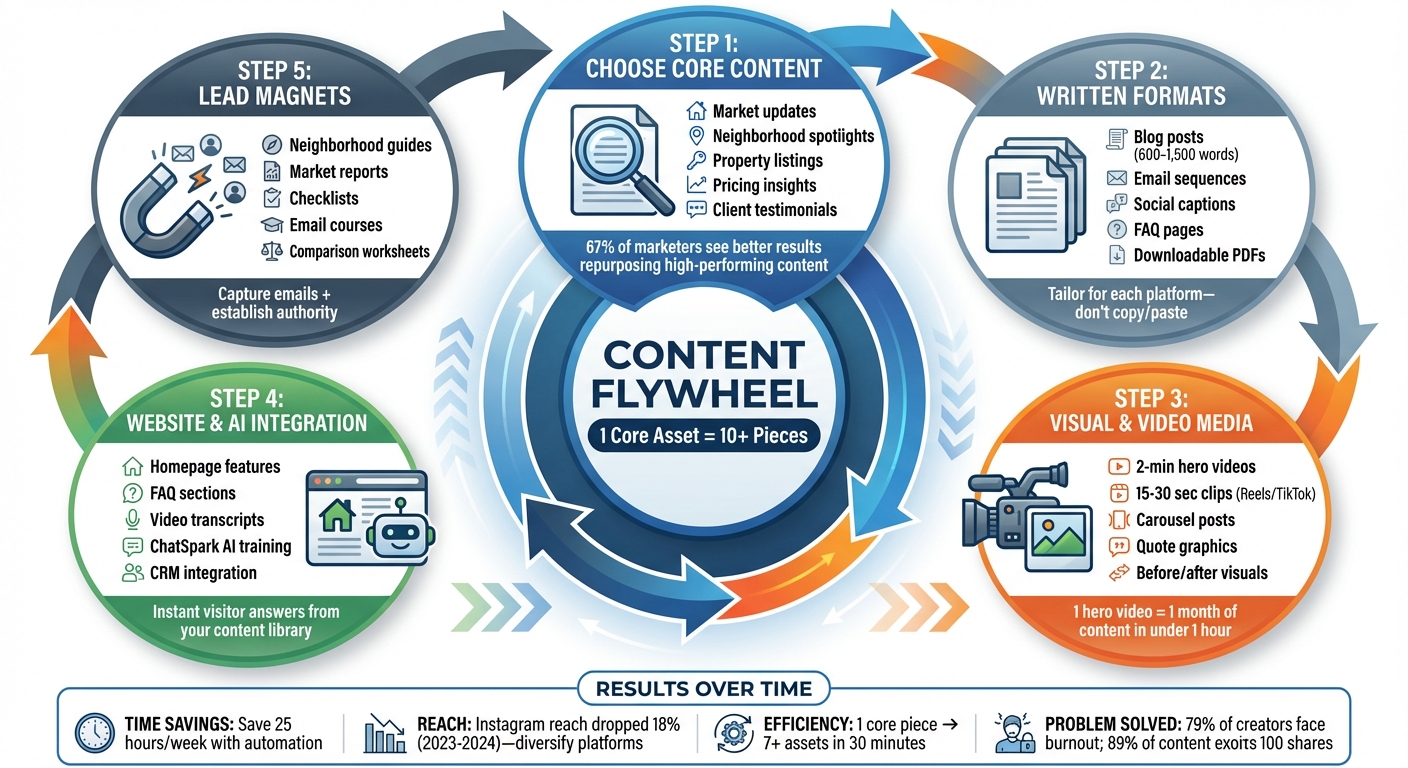
Real Estate Content Flywheel: 5-Step Process to Turn One Post Into 10 Assets
How to REPURPOSE Real Estate Content the RIGHT Way
Why Agents Struggle to Create Content Consistently
The problem isn’t a lack of ideas – it’s the absence of a reliable system. Many agents fall into what’s called the "net new" trap: the constant pressure to churn out fresh content daily instead of making the most of what they already have. This approach often leads to burnout and inefficiency, especially when juggling multiple platforms. The numbers back this up.
For instance, Instagram’s average reach rate dropped by 18% between January 2023 and August 2024 [5]. This decline shows how spreading limited resources too thin can hurt performance.
Burnout is another major issue. In 2024, 79% of business-focused creators admitted struggling with burnout [5]. On top of that, time-consuming tasks like paperwork and compliance eat into the energy needed for creative work, often stalling content production before it even gets off the ground.
Another common mistake? Agents tend to create one-off posts that aren’t repurposed for other platforms. Take a property listing, for example – it could easily be transformed into multiple pieces of content, yet it’s often posted once and forgotten. This is a missed opportunity. Research shows that 67% of marketers see better results when they rework high-performing posts into new formats [5]. Despite this, 89% of content never surpasses 100 shares, highlighting how much effort goes to waste [6].
The lack of a batching strategy or streamlined workflow leaves agents scrambling for ideas week after week. Instead of reusing and repurposing proven content, they’re stuck starting from scratch. This is where an effective content flywheel can completely change the game.
Step 1: Choose Core Content for Your Flywheel
Creating a content flywheel begins with picking the right foundation. Not every piece of content is worthy of repurposing. The key is to identify content that can be created once and effectively reused across different platforms [2]. This strategy not only saves time but also amplifies your reach and impact.
Start by reviewing your recent content to find high-performing pieces. Tools like Google Analytics 4 and Google Search Console can help you pinpoint posts that resonate most with your audience. Content that already performs well is a safer choice for repurposing since it has proven its value. Prioritize assets that address common client questions; their timeless nature ensures they’ll continue to be relevant.
High-Impact Content Examples
Focus on core content that’s either evergreen or timely and directly meets your audience’s needs. For instance:
- Market updates: These establish authority with data-driven insights and can be repurposed into infographics, lead magnets, or newsletter snippets.
- Neighborhood spotlights: These stay relevant as long as the area exists and are perfect for blog posts, YouTube walkthroughs, and Pinterest boards.
- Property listings with a story: A compelling listing can evolve into before-and-after visuals, short video clips, or social media carousels.
- Pricing insights and trends: These attract attention because buyers and sellers are always searching for this type of information.
- Client testimonials: These build trust over time and can be transformed into quote graphics, video reviews, or even email signatures.
What Makes Content Worth Repurposing
Not every piece of content is worth the effort. Look for content that checks these boxes:
- Answers audience-specific questions: Think about the questions you hear repeatedly – whether it’s in Facebook Groups, on Nextdoor, or during client conversations [3][4]. If people consistently ask about topics like interest rates or staging tips, that’s a clear sign to create a core piece of content around it.
- Showcases your expertise: Your content should reflect well on your brand and position you as a local market expert [3]. Skip generic advice and focus on hyperlocal insights that highlight your unique knowledge.
- Covers a broad topic: Choose content that’s substantial enough to be broken into smaller pieces. For example, a detailed neighborhood guide or a step-by-step home-buying guide can easily be divided into at least 10 smaller assets.
Once you’ve identified the perfect core content, the next step is repurposing it into multiple formats. Up next, learn how to turn your core content into written assets that keep your audience engaged.
Step 2: Turn Core Content Into Written Formats
Once you’ve identified your core content, the next step is to adapt it for different platforms. The goal? Tailor your message to fit each channel, rather than simply copying and pasting. A 1,500-word blog post might work wonders on your website, but it’s not ideal for an email or a quick Instagram caption.
Blogs and Website Content
You can stretch the life of your core content by repurposing it into multiple blog posts. For instance, if your original piece is a detailed neighborhood guide, you could spin off a short FAQ page that answers the top three questions buyers ask about that area. Or, if your original post is titled "5 Reasons to Buy in [Neighborhood]", consider writing a follow-up like "What First-Time Buyers Should Know About [Neighborhood]."
These additional blog posts don’t need to be long. A concise 600-word article that zooms in on one specific aspect of your core content can be plenty. Not only does this keep your website fresh, but it also gives search engines more pages to index. The trick is to focus on a single angle – expand on it or simplify it – without regurgitating the entire original post.
From there, you can rework that content into email formats for more direct engagement.
Email Marketing Assets
Emails thrive on brevity. Start with a short summary that teases the most compelling insights from your core content and includes a link to the full post. For example, if your blog is a market update, your email could say: "Inventory dropped 12% last month in [City]. Here’s what this means for buyers right now." Then, provide a link for readers who want the full scoop.
You can also break your core content into automated email sequences. A comprehensive buyer’s guide, for instance, can be turned into a five-part drip campaign, with each email diving into a specific section. This keeps your audience engaged over time and ensures they’re consistently receiving value.
"Repurposing published content is one of the best ways to maximize marketing efforts and cut down on physical effort. Creating new content is time-consuming" [3]
- Nelson Quest, Founder & CEO of AgentFire
Once your email strategy is in place, it’s time to craft social-ready snippets.
Social Media Captions and Downloads
Social media thrives on bite-sized content. Pull out a key stat, quote, or insight from your blog to craft an engaging caption. For example, if your post is about staging tips, one Instagram caption could highlight just the first tip, paired with a compelling image. You might also share a client testimonial about how staging helped sell their home faster.
For LinkedIn, take a more professional approach. A blog post on pricing trends could be reframed as an analysis tailored to local investors. The core message stays the same, but the tone and framing shift to suit the platform.
You can also transform your content into downloadable resources. For example, take a "how-to" section from your blog and turn it into a one-page checklist or PDF. A post about prepping a home for sale could become a "Pre-Listing Checklist" that readers can download in exchange for their email address. These resources are quick to reference and offer value without requiring readers to sift through an entire blog post.
Step 3: Convert Core Content Into Visual and Short-Form Media
Written content lays the groundwork, but to connect with users scrolling through platforms like Instagram, TikTok, YouTube Shorts, or Facebook, you’ll need visuals and videos. The good news? Your original content already holds everything you need – just reformat it for these fast-paced platforms.
Video Content
Try the "hero" video approach. Record a vertical video (about two minutes long) that tackles a key question from your blog or article. For instance, if your post discusses "Is the market crashing?", create a clear, concise video answering that exact question. Use your phone to shoot in a 9:16 format – no need for professional gear.
From that one video, you can craft several short clips. Grab a 15-second hook – perhaps the most eye-catching statement or question – for Instagram Stories or TikTok. Cut out a 30-second actionable tip for Reels. By batch recording two or three hero videos in one session, you can generate enough short-form content for an entire month in under an hour [4].
Not comfortable on camera? No problem. You can narrate a screen recording that shows market data, property photos, or other visuals. The delivery style isn’t as important as making your message clear and engaging.
But videos aren’t the only way to extend your content’s reach – static visuals also pack a punch.
Visual Assets
Videos grab attention, but static visuals help reinforce your message. Carousel posts are especially effective on Instagram and LinkedIn. If your blog outlines a step-by-step process – like "5 Things to Do Before Listing Your Home" – turn each step into a separate slide. Tools like Canva make it easy to create professional-looking carousels, even if you’re new to design [4].
You can also create before-and-after visuals to highlight changes. For example, show a price drop over six months, a staged versus unstaged room, or shifts in local inventory. These don’t need to be elaborate; a simple side-by-side image or clean chart with bold text will do. If your post includes compelling stats, turn one into a quote graphic or bar chart. The aim is to present one idea in a way that’s quick and easy to digest – don’t overload a single image with too much information.
These visuals and videos allow your core content to reach more people, fitting seamlessly into the same content strategy loop.
Step 4: Add Repurposed Content to Your Website and Chat Tools
Now that you’ve created your written and visual assets, it’s time to put them to work. By embedding this repurposed content across your website and integrating it into your chat tools, you can enhance engagement and make your site more interactive. Let’s break it down.
Boost Engagement on Your Website
Your repurposed content can breathe new life into your site without requiring constant updates. For example, if you’ve published a neighborhood spotlight on downtown condos, take a key statistic or insight and feature it on your neighborhood hub page. Similarly, if your market report includes pricing trends, you can add a summary or chart to your homepage or a buyer resources section.
Video transcripts are another great way to maximize your content. Say you’ve recorded a short video explaining mortgage rate changes – transcribing that video and adding the text to a relevant page can improve accessibility for users who prefer reading. Plus, it gives search engines more text to crawl, which can help boost your SEO effortlessly [3][4]. The same goes for FAQ content. If your blog addressed the question, "Should I wait to buy until rates drop?", turn that into a standalone FAQ section on your buyer guide page. It’s a simple way to reuse content while making your site more helpful.
Use Your Content to Train Conversational AI
Your repurposed content can also power AI tools like ChatSpark, enabling them to answer visitor questions instantly. Instead of waiting for a response, visitors can get accurate answers pulled directly from your blog posts, market reports, or neighborhood guides. For instance, if someone asks about school ratings in a specific area, ChatSpark can reference your neighborhood spotlight and provide the information right away.
To make this work, you’ll need to program common questions and answers from your top-performing content into the AI’s knowledge base. For example, if your market report discusses inventory trends, feeding that data into ChatSpark equips it to respond to questions like, "Is it a good time to sell?" You can also set up behavioral triggers. If a visitor spends more than 30 seconds on a listing page, the AI could suggest similar homes or offer to schedule a tour.
ChatSpark can even take the initiative by asking, "Would you like to see recent sales in this neighborhood?" or "Interested in a private tour of this home?" When synced with your CRM, these conversations, along with contact details and tour requests, are logged automatically – making follow-ups a breeze.
Step 5: Turn Core Content Into Lead Magnets
Once you’ve started repurposing your written and visual content, the next step is to transform that core material into lead magnets. These are resources designed to attract traffic and capture leads by offering valuable, gated content. By reworking your existing content, you not only provide meaningful resources to potential clients but also grow your email list in the process.
Examples of Lead Magnets
Start by identifying your best-performing content and repackage it into downloadable resources like guides, checklists, or even email courses. For instance, if you’ve published a detailed market report on pricing trends, you could turn that data into a "Home Buyer’s Market Guide" or a localized investment resource [1][3]. These types of localized, data-rich tools can help establish your credibility in specific markets [3].
Another idea: take a neighborhood spotlight post and create a downloadable "Neighborhood Guide", complete with school ratings, local amenities, and recent sales figures. A post tackling the question, "Should I wait to buy until rates drop?" could easily become a downloadable guide or a short email series that nurtures leads over time – no constant follow-up required [7].
You can also simplify complex processes for your audience. For example, turn a blog post about preparing a home for sale into a "Pre-Listing Home Prep Checklist" or a "Home Staging Checklist." First-time buyers would appreciate a checklist that walks them step-by-step through what can often feel like an overwhelming process [3].
Match Lead Magnets to Real Client Questions
The most effective lead magnets solve specific pain points or misunderstandings that clients frequently bring up in conversations [6]. For example, if sellers often ask how to increase their home’s value, create a resource like "5 Low-Cost Updates That Boost Home Value." If buyers are stuck deciding whether to rent or buy, offer a downloadable comparison worksheet to guide them through the decision-making process.
The key is to make your lead magnets feel like natural extensions of your existing content. Let’s say you write a blog post explaining mortgage terms. Offering a "Mortgage Terms Glossary & Calculator" as a free download makes perfect sense – it’s a logical next step that adds value for the reader. Websites with consistent, active content strategies tend to generate far more traffic and leads than those without [6]. And when lead magnets address real client needs, they convert much more effectively.
How the Content Flywheel Builds Value Over Time
The magic of a content flywheel isn’t in what it achieves right away – it’s in how it builds momentum over months of consistent effort. By repurposing content strategically, you deepen your presence across platforms, strengthen your expertise, and streamline your overall strategy.
SEO and Channel Engagement
Smart content repurposing can work wonders for your SEO. Imagine transcribing video tours, turning market updates into blog posts, or creating neighborhood guides. These efforts boost your keyword relevance without having to start from scratch [3][4]. For example, you can target hyperlocal phrases like "3-bedroom colonial in [Neighborhood Name]" or address specific, long-tail questions that buyers are actively searching for. These kinds of terms often face less competition but attract users with higher intent.
Sharing your core ideas across platforms like Medium, LinkedIn, or even guest blogs also helps you earn quality backlinks, which search engines love when ranking websites. Plus, regularly updating or resharing older content signals to Google that your site is active and relevant, further establishing your authority. Over time, this consistent effort builds a level of credibility that’s tough to achieve with one-off posts.
Consistency across platforms is just as important. When someone catches your market insights on Instagram, reads a related blog post on your website, and then receives a follow-up email featuring a downloadable guide, your message becomes memorable. These multiple touchpoints increase the chances that your audience will think of you when it’s time to make a decision [3].
And let’s not forget – this SEO boost comes hand-in-hand with major time savings for content creation.
Time Savings and Scalability
The flywheel approach is a game-changer for saving time. Start with one "hero" piece, like a 2-minute video, and you can generate an entire week’s worth of content – seven or more pieces – in under 30 minutes [4]. Why? Because the hard work – research, scripting, and crafting the core message – is already done. All you’re doing is transforming that single piece into different formats: a carousel post, a short video, a quote graphic, a caption, an email, or even a story series [8].
Keeping your past content organized in a spreadsheet or digital hub makes refreshing and reusing assets even simpler months or even years down the line [1][2]. Instead of starting from scratch for every social post or email, you can pull from a library of tried-and-true material. Brokerages can take this a step further by centralizing key campaigns – templates, market data, and messaging – so agents only need to add a local spin instead of creating everything from the ground up [2]. The result? Higher output with less effort and a system that scales effortlessly.
Conclusion
The content flywheel changes the game by focusing on working smarter, not harder. Instead of treating every platform like a separate project, it encourages you to create one solid piece – like a market update, neighborhood highlight, or property story – and adapt it for multiple formats. That same content can fuel blogs, emails, social media posts, videos, chats, and even lead magnets. You do the research once, keep the distribution steady, and avoid overwhelming your workload.
This approach strikes the perfect balance between efficiency and quality. By batching your content creation and reusing what resonates, you maintain a steady presence across platforms without constantly scrambling for fresh ideas. The time saved on tasks like brainstorming, research, and formatting quickly adds up. In fact, marketers who integrate automation and streamlined repurposing save an average of 25 hours per week [5].
The flywheel approach builds momentum over time. It strengthens your SEO, reinforces your brand identity across channels, and transforms your content library into a lasting asset. What starts as a single post evolves into a system that drives visibility, builds authority, and generates leads – all without the stress of starting from scratch every day.
This isn’t about doing more; it’s about creating content that works harder for you. It ensures a consistent, sustainable presence wherever your audience spends their time, all while helping you avoid burnout and stay ahead in the game.
FAQs
How do I choose the best content to start my real estate content flywheel?
To select the most effective content for your flywheel, focus on materials that are helpful, flexible, and engaging for your audience. Great options include local market updates, neighborhood highlights, property listings with compelling stories, pricing trends, or answers to frequently asked buyer and seller questions. These types of content naturally draw interest, can be reused over time, and offer plenty of opportunities for repurposing into blogs, emails, social media posts, videos, and more.
Here are a few things to consider:
- Does it address a real need? Content that tackles common questions or offers timely insights – like "What’s the average price per square foot in [your area]?" – tends to be highly shareable and useful.
- Is it packed with reusable elements? A listing with stunning photos, engaging videos, and a strong narrative can be transformed into multiple formats effortlessly.
- Can it be broken into smaller pieces? For example, a market update could be turned into an email headline, a social media infographic, or even a downloadable guide.
Starting with content that meets these criteria sets a solid foundation for your flywheel, helping you achieve maximum results without unnecessary extra work.
How can I repurpose real estate content effectively across different platforms?
Repurposing real estate content is all about taking one strong piece and reshaping it to fit different platforms and formats. Let’s say you have a market update or a property listing – this can be turned into short social captions for Instagram or LinkedIn, transformed into carousel slides for a more visual approach, or even edited into a 15-30 second video for TikTok or Reels. You can also expand on the same topic by creating a blog post, an email newsletter, or a downloadable guide like a buyer’s checklist.
To broaden your reach, think about transcribing videos into blog snippets, designing infographics or charts for Pinterest, or recording a podcast episode on the subject. By strategically reworking your content, you can produce blogs, emails, social posts, videos, and even lead magnets – without starting from scratch. This method ensures your content does more of the heavy lifting for you.
How does the content flywheel strategy enhance SEO and audience engagement?
The content flywheel takes a single core piece of content and spins it into a variety of formats – like blog posts, email campaigns, social media updates, videos, and even chatbot responses. This method not only enhances SEO by introducing fresh keyword variations and increasing indexed pages but also encourages backlinks. Plus, maintaining a consistent presence across multiple channels ensures your audience sees your message repeatedly, leading to more clicks, shares, and engagement on your site. By repurposing high-quality content strategically, you amplify its reach and effectiveness without piling on extra work.


