
Sellers today are informed and prepared. They research agents online, analyze market trends, and often compare multiple agents before making a decision. To stand out, your listing presentation must address their top priorities with clear, data-backed strategies. Here’s what sellers want:
- Proof, Not Promises: Back up claims with measurable results (e.g., "My listings sell 12 days faster than the neighborhood average").
- Detailed Marketing Plans: Explain how their home will be showcased online, including platforms, targeted ads, and the use of visuals like 3D tours and drone footage.
- Transparent Pricing Logic: Use data to justify pricing recommendations using tools like an automated home valuation plugin and explain adjustments for market conditions.
- Regular Communication: Establish a consistent update schedule with clear milestones, such as weekly reports and showing feedback.
- Buyer Demand Evidence: Provide data on buyer interest, including database leads, online engagement, and market activity.
- Buyer-Focused Messaging: Craft descriptions that highlight benefits and appeal to buyer psychology, not just features.
Key takeaway: Sellers want a professional who prioritizes their goals, communicates effectively, and uses data to deliver results. Your presentation should be concise, focused, and tailored to their needs.
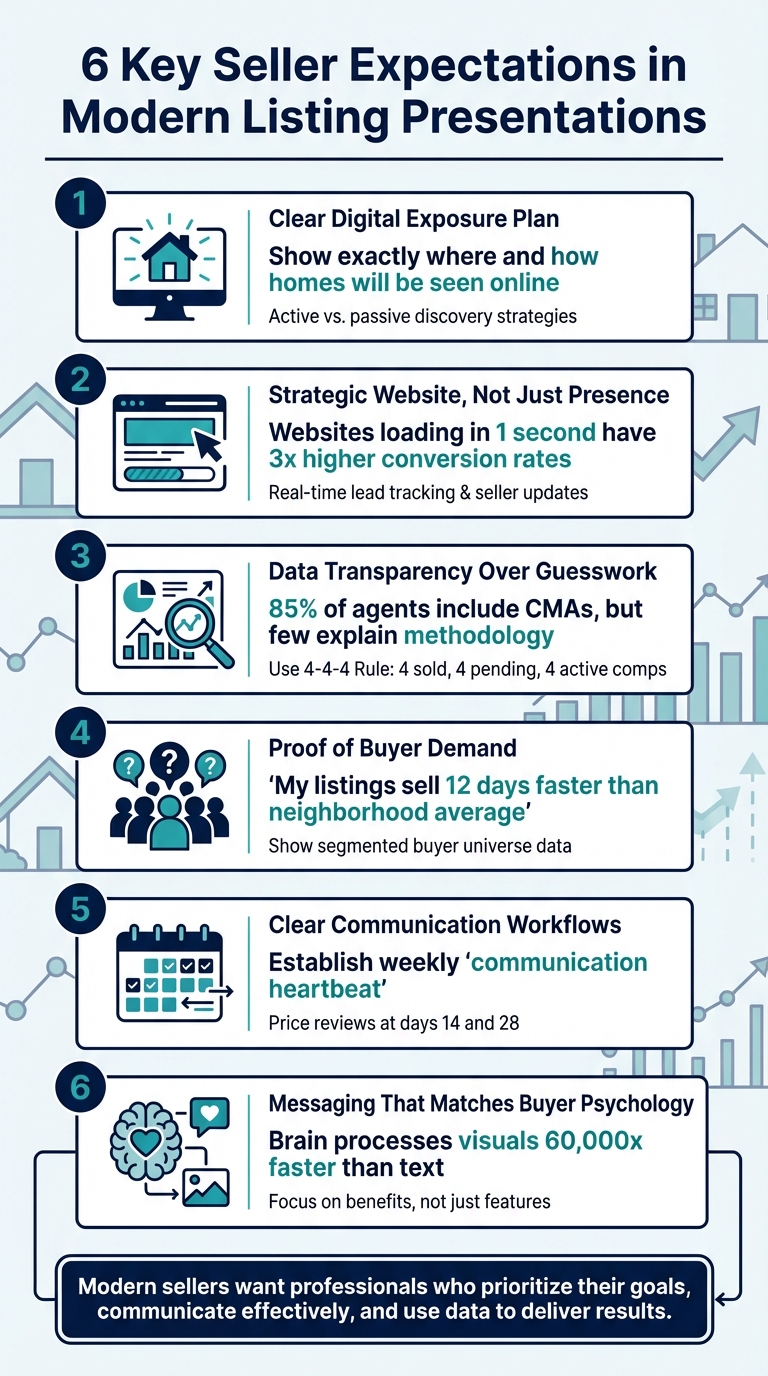
6 Key Seller Expectations in Modern Listing Presentations
How Seller Expectations Have Changed
What Sellers Expect Today
Sellers today come to the table well-informed. They track national housing trends, keep an eye on online property valuations, and monitor mortgage rate fluctuations. By the time they meet with you, they’re not looking for surface-level information – they want a professional who can break down how these broader trends affect their specific local market [8] [3].
With easy access to data, seller priorities have shifted. Strategic pricing and effective property marketing now top their list, each accounting for 23% of their concerns [9]. Sellers expect presentations that go beyond generic claims, offering data-driven insights like how long homes in their area are staying on the market compared to neighborhood averages [5]. In short, they’re looking for a clear, actionable strategy.
Today’s sellers also demand a multi-channel digital approach. They want to know exactly where their property will be listed, how potential buyers will find it, and how the campaign’s success will be measured. Tools like 3D virtual tours, AI-powered pricing solutions, and social media retargeting have raised the standard for marketing plans [9] [2]. These innovations not only boost property visibility but also help build the trust needed to secure listings.
Communication is another critical factor. Sellers expect regular updates and detailed insights into how their home is being marketed to attract buyers. As Dave Ramsey wisely advises:
"When getting help with money, whether it’s insurance, real estate or investments, you should always look for someone with the heart of a teacher, not the heart of a salesman" [8].
What No Longer Works
As seller expectations evolve, outdated approaches have become glaringly ineffective. Starting a meeting by listing awards or boasting about years of experience doesn’t resonate with sellers who are laser-focused on achieving their specific goals [7] [8]. Similarly, generic marketing checklists now feel impersonal and out-of-touch [1] [6].
Vague promises like "maximum exposure" fail to inspire confidence. Sellers respond better to precise statements such as, "My listings sell 12 days faster than the neighborhood average", or, "I have X number of active buyers in my database who match your property profile" [5] [2]. Visual aids are also essential – relying solely on text-heavy slides can dilute your message, especially when visuals are processed 60,000 times faster by the human brain [8].
Other outdated tactics, like using old PowerPoint templates, offering one-size-fits-all marketing plans, or basing pricing on intuition rather than data, can erode trust. Modern sellers value concise, focused presentations. They prefer meetings that last 30–45 minutes, packed with relevant insights, rather than drawn-out sessions filled with unnecessary details [1]. They’re looking for clarity and expertise – not a sales pitch.
Expectation #1: A Clear Digital Exposure Plan
Where and How Homes Are Seen Online
Sellers want to know exactly how their homes will be found by buyers. The journey from an online search to an in-person showing involves several key steps: syndication through the MLS to major platforms like Zillow and Realtor.com, targeted social media ads on platforms like Facebook and Instagram, and personalized outreach via agent networks and CRM databases [10][2].
Modern exposure plans, often incorporating various real estate marketing ideas, should clarify the difference between active discovery (buyers actively searching on listing portals) and passive discovery (buyers encountering ads on social media or other platforms). Sellers appreciate specifics like: "Your listing will show up in searches for buyers looking under $500,000 or within the $450,000–$500,000 range due to price bracketing," or "We’ll run geo-targeted ads to reach buyers within a 15-mile radius who’ve shown interest in similar properties." Providing this level of detail transforms generic promises into a clear, actionable strategy [2].
High-quality visuals are now a must. Professional photos, 3D virtual tours, detailed floor plans, and drone footage are no longer optional – they’re essential [2][3]. Sellers understand that these visuals directly impact how many clicks and showing requests their listing receives.
Breaking down these components helps set the stage for demonstrating how your approach stands out.
What Sets Your Exposure Plan Apart
To stand out, show sellers how your plan delivers measurable results and connects directly with buyers. Highlight the "Buyer Universe" by dividing it into four key groups: active buyers in your database, passive buyers in your CRM who fit the property profile, active buyers searching on listing portals, and passive audiences reached through social media ads [2]. For example, saying, "I currently have 47 active buyers in my database who are looking for homes in your price range and neighborhood," turns abstract ideas into concrete proof.
What really elevates modern exposure plans are reverse prospecting and retargeting strategies. Reverse prospecting involves identifying and reaching out to potential buyers already in your system who match the property. Retargeting ensures that users who’ve previously viewed the listing – or similar homes – see the property again online [2]. These strategies show sellers that you’re not just listing their home and waiting – you’re actively working to connect with qualified buyers. Including past campaign results, like views, click-through rates, or inquiries, adds even more credibility to your approach [2].
Expectation #2: Website Strategy, Not Just a Website
How Buyers Interact with Listing Pages
Sellers today care about more than just having a website – they want a platform that works for them. That means technical SEO essentials like lightning-fast load times, stunning visuals, and features designed to keep buyers engaged. Did you know that websites loading in just 1 second boast conversion rates three times higher than those taking 5 seconds? And nearly 40% of users won’t wait around if a site takes more than 3 seconds to load. Tools like Google PageSpeed Insights can help ensure your site meets the sub-3-second benchmark.
But speed is just the beginning. Sellers want to know their listings will stand out. High-resolution photos are essential, but they’re no longer enough. Features like 3D virtual tours, detailed floor plans, and short video walk-throughs (around 2-3 minutes) can significantly extend buyer engagement on a page [2][6]. It’s also important to showcase how the listing page works – walk sellers through the layout, demonstrate how buyers can save searches, mark properties as favorites, and set up alerts for similar homes. These tools don’t just improve the buyer experience; they help keep listings top of mind.
Sellers also expect their property to rank in local Google searches, not just show up on third-party platforms. If your site incorporates crawlable IDX integration – like using a WordPress IDX plugin such as CT IDX Pro+ – explain how this approach creates search-engine-friendly pages that boost organic traffic. Sellers understand that greater visibility leads to more showings and, ultimately, faster sales.
This level of functionality not only enhances the buyer experience but also sets the foundation for transparent, real-time lead tracking.
Lead Tracking and Seller Updates
A successful website strategy doesn’t stop with attracting visitors – it’s about converting those clicks into real buyer interest. Sellers want to see proof that your website isn’t just generating traffic but actively capturing qualified leads. Show them your CRM dashboard in action, where you can track buyer activity in real time. Highlight key insights, like which buyers clicked on their listing, how long they stayed, and whether they saved the property or requested more details. This kind of transparency builds instant trust.
To keep sellers informed, establish a consistent communication routine – something like a weekly "Communication Heartbeat." For example, you could share metrics every Thursday at 10 a.m., including listing views, click-through rates, and showing requests directly from your website [2]. Automating this process through CRM integration ensures sellers receive timely updates without any extra effort on your part. Knowing they’ll hear from you regularly helps ease any concerns about being left out of the loop.
Take it a step further with reverse prospecting, which matches listings to ready buyers. By showing sellers how every piece of your digital strategy works together to attract serious interest, you’ll demonstrate your commitment to getting results. Walk them through the process live to make it even more impactful.
Expectation #3: Data Transparency Over Guesswork
Explaining Pricing Logic Clearly
Sellers often come into listing presentations with a price in mind. That number might stem from sentimental value or online estimates that don’t always hit the mark. Your role isn’t to tell them they’re wrong – it’s to help them see why the market suggests otherwise. While over 85% of agents include a Comparative Market Analysis (CMA) in their presentations, not all CMAs leave a lasting impression[9]. What sets a CMA apart is how effectively it tells the story behind the numbers.
Structure your CMA around three key data sets: sold, pending, and active listings. This approach highlights market trends without overwhelming sellers. A great strategy is the 4-4-4 Rule: select four properties in each category that closely match the home’s condition and location[2]. Then, walk sellers through each comparable property and explain the adjustments. Don’t just say a property sold for $450,000 – break it down. Was it the upgraded kitchen, the corner lot, or the extra bathroom that added value? When sellers understand why certain homes command certain prices, they start to trust the data and see pricing as evidence-based, not guesswork.
Keep your language simple and relatable. Instead of saying “absorption rate,” try, “There are only two months’ worth of homes available, so buyers are competing for every listing”[5]. Use visuals like bar charts to show median sale prices or infographics to explain price-per-square-foot trends. When discussing market conditions, be specific: a seller’s market has less than six months of inventory, a balanced market has six, and a buyer’s market has more than six[3].
Another powerful tool to share with sellers is the Price Derivative concept. A simple visual can demonstrate how pricing a home even 10% above market value drastically limits the pool of potential buyers[4]. When sellers see how strategic pricing increases exposure to serious buyers, they’re more likely to align with your recommendations.
Breaking down comparable data in this way doesn’t just clarify the pricing process – it builds trust by showing sellers you’re informed, transparent, and working in their best interest.
How Methodology Builds Trust
Once sellers understand your pricing logic, the next step is to show them how you arrived at your conclusions. Sellers don’t just want a number – they want to know the reasoning behind it and what happens if the market doesn’t respond as expected. While about 80% of agents provide an estimated home value, fewer take the time to explain the methodology behind that number[9].
Take sellers through your adjustment process step by step. If you’re comparing their three-bedroom home to a four-bedroom property, explain the dollar value you’re subtracting for the extra room. If one comparable has a finished basement and theirs doesn’t, show how that impacts the price. This attention to detail positions you as a trusted advisor. As financial expert Dave Ramsey puts it:
"When getting help with money, whether it’s insurance, real estate or investments, you should always look for someone with the heart of a teacher, not the heart of a salesman." – Dave Ramsey, Financial Author and Radio Host[8]
When sellers can see the logic behind every adjustment, they feel informed and empowered during what is likely the biggest financial transaction of their lives.
Set expectations early by establishing a pricing review schedule. Let sellers know you’ll revisit the price at 14-day and 28-day intervals, based on showing activity and market feedback[2]. Framing these adjustments as part of the plan from the start helps reduce uncertainty and builds confidence in your ability to adapt to market conditions.
It’s also important to address common misconceptions. Many sellers assume all homes are selling above asking price. Use local data to debunk this myth by showing the percentage of homes in the neighborhood that sold below, at, or above list price in the past 90 days[6]. Being honest – even when it’s not what sellers want to hear – earns their respect and strengthens your credibility.
Finally, integrate digital CMA tools to streamline the process. These tools pull real-time data and automate adjustments, combining efficiency with transparency. Modern sellers appreciate the speed, but what they value most is understanding the process. When they see how you arrived at the price, they trust the outcome – and they trust you.
Expectation #4: Proof of Buyer Demand, Not Promises
Using Data to Validate Demand
Gone are the days when vague assurances about potential buyers were enough. Sellers now expect hard evidence showing that buyers are actively searching for homes like theirs. For example, a modern agent might say, "My listings sell 12 days faster than the neighborhood average" [5]. This kind of specific, data-backed statement turns a general claim into something measurable and credible. It’s not about promises anymore – it’s about proof.
To take it a step further, agents can showcase the Buyer Universe by presenting segmented data. This includes active buyers in their database, CRM leads, search portal activity, and real estate social media marketing metrics like page views and tour clicks [2][9]. Adding lender insights, such as the number of pre-approved buyers within the seller’s price range, provides even more concrete evidence [2]. This approach shifts the narrative from "buyers might be interested" to "here’s exactly where the demand is coming from."
Inventory data also plays a key role. Sellers need to understand market conditions in simple terms. For instance, explaining that there’s less than six months of housing inventory indicates a seller’s market, where buyers are competing for limited listings [3]. Avoid confusing jargon like "absorption rate" and instead say something like, "There are only two months’ worth of homes available, which means buyers are actively competing for properties like yours" [5].
Visual tools help sellers grasp how pricing impacts buyer interest. For example, pricing at market value typically attracts 60% of active buyers, while pricing 10% above market value reduces that pool to just 30% [4]. These visuals make it clear that strategic pricing isn’t about losing money – it’s about maximizing exposure to serious buyers.
What Counts as Weak Proof
Not all data builds trust. Claims like "I’m a top producer" or "I have a strong social media presence" fall flat because they lack the context and specifics sellers need. Outdated statistics, such as year-old market reports or association data from previous quarters, also fail to inspire confidence [6]. Sellers want real-time data that reflects the current market, not last year’s trends.
Metrics without a clear connection to the seller’s property are equally unconvincing. For instance, showing total website traffic without explaining how it translates into buyer interest for their specific home doesn’t prove demand – it just proves you have a website. Sellers care about relevance, not just numbers. Similarly, quoting third-party statistics like "homes in this ZIP code receive an average of 1,200 online views" only matters if you explain how your marketing plan will direct those views to their listing.
Standard slides about data syndication also miss the mark. Sellers already assume their home will be listed on major platforms – that’s basic. What they really want to know is how their listing will stand out among hundreds of others in the same market [2].
"Most of the time, the myth is broken when we share that not all homes are selling over asking price – and the proof is in sharing the details." – Praful Thakkar [6]
Sellers value honesty backed by data far more than inflated promises. Real proof not only validates buyer interest but also demonstrates the thorough and thoughtful strategy you bring to the table. It’s this level of transparency that earns their trust and confidence.
Expectation #5: Clear Communication Workflows
Presenting Your Communication Plan
Sellers appreciate knowing when and how they’ll receive updates. To meet this need, establish a "communication heartbeat" – a set day and time each week for sharing updates, whether there’s major news or not [2]. This approach ensures sellers never feel left in the dark or have to chase you for information.
Your communication plan should address four key phases:
- Pre-listing updates: Delivered 24–48 hours before major milestones.
- Active listing reports: Weekly status calls to keep sellers informed.
- Market checkpoints: Formal pricing reviews scheduled for days 14 and 28.
- Offer management: Immediate summaries of terms and net proceeds when offers come in [2].
Additionally, provide feedback immediately after every showing and open house. Share buyer reactions and outline any recommended next steps to keep the process transparent and actionable [2][11].
How Consistency Builds Confidence
A consistent communication schedule does more than just inform – it reassures. Sellers feel confident when they know exactly when they’ll hear from you. Regular updates alleviate anxiety, showing them you’re actively managing their listing. For example, sending a "Meeting Game Plan" email on the morning of the listing appointment, complete with a brief agenda, sets a professional tone and builds trust from the outset [2].
Stick to the outlined update phases and deliver weekly updates without fail. Include meaningful metrics like listing views, repurposing content for social media performance, and database inquiries. Highlight any new competing listings or shifts in mortgage rates that could influence buyer behavior. This level of detail keeps sellers informed and helps them feel secure throughout the process [2].
"If you ever need to chase us for an update, we haven’t done our job." – Propphy [2]
When sellers feel consistently informed, they’re more likely to trust your pricing strategy, follow your recommendations, and stay patient during negotiations. Predictable communication isn’t just courteous – it’s a powerful tool for building trust and maintaining a competitive edge.
Expectation #6: Messaging That Matches Buyer Psychology
Writing Buyer-Focused Descriptions
Crafting property descriptions that truly connect with buyers goes beyond listing features. Instead of just stating, "4 bedrooms, 3 baths, new roof", focus on the benefits these features provide. For example, say, "Enjoy peace of mind with a roof guaranteed until 2025 and plenty of space for a growing family." This shift helps buyers see how the home fits into their lives.
To make your messaging resonate, think about your "Buyer Universe" and broader marketing strategies for real estate agents. This includes active buyers in your database, CRM leads, users on search portals, and even passive social media followers. Tailor your descriptions to appeal to these groups, factoring in neighborhood demographics like age, income, and family size to attract the right audience.
Descriptions that focus on lifestyle sell better than those packed with dry specs. Highlight nearby parks, schools, restaurants, or community features that enhance daily living. Consider creating a short video walk-through (2–3 minutes) to showcase not just the home but the surrounding neighborhood. This visual storytelling helps potential buyers imagine their lives in the space, making it more than just a house tour.
Dig deeper with sellers to uncover emotional selling points. Ask questions like, "What’s your favorite room in the house?" or "What made you fall in love with this home when you bought it?" These insights can help you craft descriptions that strike an emotional chord with buyers. For instance, instead of just saying, "Freshly painted walls", you could say, "Move-in ready with a fresh, modern look that brings peace of mind."
If you’re looking for more ways to create descriptions that convert, check out these website copywriting tips for real estate leads.
Aligning your messaging with buyer psychology – just like clear digital plans and transparent data – builds trust and strengthens your connection with potential buyers.
Common Messaging Mistakes to Avoid
While a well-crafted description can captivate buyers, certain mistakes can quickly turn them away.
One common misstep is focusing too much on the agent’s accomplishments rather than the buyer’s needs. Buyers can sense when descriptions feel more like self-promotion than helpful guidance. Another pitfall is overwhelming them with industry jargon or overly technical details. Terms like "absorption rate" or "market liquidity" might sound impressive, but they can leave buyers confused and disengaged.
"When getting help with money, whether it’s insurance, real estate or investments, you should always look for someone with the heart of a teacher, not the heart of a salesman." – Dave Ramsey
Another mistake is "feature dumping" – listing every upgrade without context. Instead, focus on the features that matter most to your target audience and explain why they’re valuable. For example, don’t just say "new HVAC system"; say, "Stay comfortable year-round with a recently upgraded HVAC system designed for energy efficiency."
Avoid using generic, cookie-cutter descriptions that make the property feel like just another listing. Tailor your messaging to the specific property type. A downtown high-rise condo, for instance, calls for a different tone and focus than a suburban family home. Also, steer clear of seller-centric phrases like "owner’s suite" or "pride of ownership", which can make it harder for buyers to picture themselves in the space.
Finally, remember the power of visuals. The human brain processes images 60,000 times faster than text, and visuals can make presentations 43% more persuasive [8]. High-quality photos, 3D tours, and detailed floor plans can enhance your descriptions, creating a cohesive story that reduces buyer hesitation and speeds up decision-making. When your text and visuals work together, you build a stronger emotional connection with potential buyers.
How to Structure the Modern Listing Presentation
The Right Order for Key Sections
The flow of your presentation matters – a lot. Today’s sellers value clarity and logic over flashy theatrics. Start by focusing on connection. Ask about their goals, timeline, and priorities for the sale before jumping into data. This "listen first" approach builds trust and shows you’re prioritizing their needs, not just showcasing your accolades.
Once rapport is established, begin with a property walkthrough. This step lets you identify standout features and suggest potential improvements on the spot. Tailoring your pricing and marketing strategy to the home’s unique qualities makes your approach feel custom, not cookie-cutter. After that, transition into market analysis. Use a Comparative Market Analysis (CMA) to present active, pending, and sold listings, grounding your recommendations in facts rather than overly optimistic projections.
Next, dive into your exposure strategy. Be specific – explain where the listing will appear, how buyers will find it, and what sets your digital marketing apart. Follow this with a breakdown of pricing logic. Use price bracketing to show how buyers search in ranges and why strategic positioning is key. Wrap up by outlining your communication plan: weekly updates, feedback from showings, and pre-scheduled price reviews at 14 and 28 days. This structure keeps sellers informed and engaged without overwhelming them, aligning perfectly with the transparent, data-driven approach discussed earlier.
"The most important thing to remember about the listing appointment… is that it’s about the seller – not you." – Robin Brodsky, Broker-Owner [3]
Keep your presentation concise – aim for 45 to 60 minutes to hold their attention [1][2]. Use clear transitions, focus on the essentials, and make sure your data is easy to follow. Pairing a logical sequence with strong visuals can make all the difference.
Using Visuals to Improve Clarity
A well-structured presentation becomes even more effective when paired with impactful visuals. Visual aids simplify complex data, making it easier for sellers to grasp your key points. Instead of lengthy explanations, use bar charts to show your average Days on Market compared to local benchmarks or infographics to outline the home-selling process. These visuals not only clarify your message but also help sellers retain the information [7][8].
Leverage data visualization to back up your claims. For example, instead of saying, "I sell homes quickly", display a chart showing, "My listings sell 12 days faster than the neighborhood average" [5]. Visuals like these make it easier for sellers to understand how pricing impacts buyer interest and where demand lies [2][4].
Keep your slide deck streamlined – limit it to 15–18 slides that focus on clarity [5]. Each slide should convey one idea, using simple graphs or side-by-side comparisons rather than dense text. High-quality visuals don’t just support your points – they make your strategy feel deliberate and trustworthy.
When your data and visuals work together seamlessly, sellers gain a clear understanding of the reasoning behind your recommendations. That clarity builds confidence far more effectively than any verbal promise ever could.
Conclusion
Key Takeaways for Agents
Today’s listing presentations are all about creating alignment, not just persuasion. Modern sellers expect more than generic pitches – they want a clear digital exposure plan, an engaging, modern real estate website, transparent pricing insights, evidence of buyer demand, perhaps through a real estate AI chatbot that captures lead interest, structured communication, and messaging that speaks directly to buyers. In short, they want to see that your strategy is intentional and tailored to their needs.
Data turns vague promises into undeniable proof. Instead of saying, "I sell homes fast", show sellers how your metrics outperform local averages [5]. For instance, highlight specific stats like your list-to-sale price ratio or average days on the market. Visual aids can make complex market data easier to digest, and studies show that presentations with visuals are 43% more persuasive than those without [7].
Take on the role of an advisor by truly listening to your clients [6]. Ask thoughtful questions to uncover their goals, timelines, and concerns before suggesting a strategy. As Suzanne and Tony Marriott wisely advise:
"Listen to the sellers. Ask questions that speak to their objectives. Propose a strategy that helps them meet their objectives" [6].
This approach helps sellers feel understood and valued rather than just being "sold" a service.
How Alignment Leads to Seller Confidence
When your presentation aligns with what sellers expect, it naturally builds trust. Sellers who grasp the reasoning behind your pricing strategy, see proof of buyer interest, and know exactly when and how you’ll communicate feel informed and confident. That clarity reduces their anxiety and speeds up their decision-making process [2].
Alignment also creates momentum. While 42% of sellers find their agents through referrals, 68% still interview multiple agents before choosing one [4]. The agents who stand out are those who offer transparency, customization, and a clear communication plan – not through flashy promises, but by demonstrating expertise. Sellers appreciate brevity, clarity, and professionalism. They want a strategic partner who can break down market realities in simple terms and back up every recommendation with solid data. When your strategy aligns with their expectations, sellers feel empowered – and that confidence leads to faster, smoother closings.
Live "Listing Presentation" & Handling Tough Seller Objections
FAQs
How can I make my listing presentation more data-driven and credible?
When crafting a listing presentation that resonates with clients, it’s crucial to include clear, actionable market insights that back up your pricing and marketing strategies. Leverage tools like comparative market analyses (CMAs), buyer demand trends, and performance metrics to provide a transparent, data-driven foundation that builds trust.
Make sure to present this information in a simple, visual format – think charts, graphs, or infographics. Visuals help break down complex data, making it easier for clients to grasp. Steer clear of vague assurances; instead, focus on specific, measurable outcomes, such as projected online visibility or engagement rates. This kind of evidence-based approach shows sellers that your strategy is grounded in facts, not speculation.
What are the most effective digital marketing strategies for selling a home today?
The most effective digital marketing strategies for selling a home today center on smart online exposure, data-backed insights, and clear communication. Sellers want a straightforward plan that outlines where their home will be showcased, how buyers will find it, and what makes your approach stand out. Focusing on website visibility, buyer search habits, and how easily listings can be discovered helps build trust while showcasing your expertise.
A strong website strategy goes beyond simply having a site. It’s about how listings are displayed, ensuring fast page load times, and creating a seamless path from buyer interest to action. Sellers also appreciate insights grounded in data – like pricing strategies, current market trends, and buyer demand patterns. These details not only reduce uncertainty but also build confidence in your process.
Lastly, providing concrete evidence of buyer interest – such as website traffic stats or search activity trends – can reassure sellers that their property is gaining real attention. Together, these tactics show a professional, results-oriented approach that appeals to today’s knowledgeable sellers.
How can I explain pricing strategies to sellers in a way that builds trust?
When working to earn sellers’ trust, it’s crucial to offer straightforward, data-backed insights into your pricing approach. Share important details like current market conditions, comparable property sales, and the specific methods you use to determine value. Being upfront about how these factors shape your pricing recommendation can go a long way.
Rather than sticking to fixed numbers, consider presenting pricing ranges or different scenarios. This not only shows that you’re adaptable but also accounts for potential market shifts. By doing so, you showcase your expertise while easing any concerns sellers might have, giving them confidence in your ability to price and market their home effectively.


