
More pages do not mean more traffic. In real estate SEO, the win comes from publishing the right pages, keeping them current with MLS data, linking them well, and reviewing them before they go live.
Here’s the short version:
- I’d focus on useful search combinations, not every possible one
- I’d publish pages only when there’s live inventory, local context, and a clear place in the site structure
- I’d use templates + automation + AI drafts
- I’d keep people in charge of market coverage, fact checks, and compliance review
- I’d watch indexation first, because pages that do not get indexed usually do not help
- I’d clean up weak pages after 90–120 days if they get no impressions
A simple example makes the point. If a brokerage covers 10 cities, 5 property types, and 4 price bands, that creates 200 possible page types. But only a small share may be worth publishing. The rest can end up thin, empty, or too similar.
That’s the shift this article explains: real estate SEO is moving from hand-built pages to controlled page networks built from live data, templates, internal links, and human review.
If I had to sum it up in one line, it would be this: the future is not maximum volume; it is selective scale.
How Real Estate SEO Moved From Static Pages to Programmatic Systems
Static pages and local blogging built the foundation
Early real estate websites were pretty simple: a homepage, an about page, a contact form, and a small batch of blog posts. City landing pages and agent bios gave buyers a place to start. Neighborhood guides helped show local knowledge and build trust.
That base still matters. A well-written guide to a specific school zone or a market update for a certain ZIP code can do something automated pages often can’t do by themselves: make the site feel grounded in the area it serves.
Manual publishing helps build authority. But it doesn’t scale across every search people type into Google. There are just too many useful combinations. That’s what pushed the shift toward structured page systems built to cover repeatable search patterns.
Programmatic SEO expanded long-tail coverage
Programmatic SEO changed the model from one-by-one writing to repeatable page creation. Instead of drafting every page by hand, brokerages started using templates powered by MLS data to publish pages for neighborhoods, property types, bedroom counts, and price ranges. Internal links, schema markup, and XML sitemaps connected those pages into a crawlable site structure.
Big sites show what this kind of structured coverage can do at scale. But for smaller brokerages, the takeaway isn’t to publish as many pages as possible. It’s to choose coverage carefully.
The risk is pretty plain: thin template pages that do little more than repeat what the MLS feed already says usually don’t help much.
AI changes workflow, not the quality standard
AI now speeds up that same workflow. What it doesn’t do is lower the bar. The practical setup is AI draft, human review.
AI can handle the repeatable parts, like pulling in market stats, price trends, and property data. Then a local agent adds context about the neighborhood and checks the facts. That’s the part that keeps a page from sounding like it could belong to any market in the country.
Google’s scaled content abuse policies apply whether a page is written by a person or generated by a model. If AI-generated content skips human review, it can hallucinate facts, produce generic descriptions that read the same across hundreds of pages, or make compliance-sensitive claims that no agent would ever approve.
Each page still needs to be useful, accurate, and relevant.
That’s why scale works only when every page still earns its place.
How to Automate SEO Without Getting Penalized (AI Secrets Revealed)
Why Page Count Is the Wrong Goal
Once you can publish at scale, the next question is simple: what should go live at all? Search engines don’t have to crawl or rank every URL you make. If your page count keeps going up while indexation keeps dropping, that usually points to weak quality or pages that don’t give users anything new.
Useful combinations beat theoretical combinations
A page earns its spot when it lines up with real search demand, has enough active listings to make browsing worth it, and brings in local details that aren’t just copied from feed data. Neighborhood pages with original local details tend to get indexed more often than generic templated pages built from MLS feed data alone. This is why SEO-optimized real estate sites prioritize crawlable structures over raw data dumps. The gap comes down to usefulness, not sheer volume.
That’s the part many brokerages miss. The number of pages that actually pays off is usually much smaller than expected, and indexation rate is the first metric to watch. [1]
Thin, duplicate, and empty pages hurt the site
Too many weak pages can pull down the strong ones. It’s not just that thin pages fail on their own – they can hurt the pages that deserve to rank. [6]
Orphan pages burn crawl budget and rarely bring in traffic that matters. If a page has no impressions after 90–120 days, it’s time to act. In most cases, that means one of a few moves:
- Consolidate it
- Canonicalize it
- Noindex it
- Remove it
A hypothetical multiplication example needs filtering
Take a brokerage that serves 10 cities, with 5 property types and 4 price brackets. On paper, that creates 200 page combinations. But only 40 of those may deserve their own pages. The other 160 would likely be thin, empty, or repetitive.
The math is easy. The filtering is the hard part.
Figures are illustrative. That filter is what turns raw combinations into a page network people can use.
How Controlled Page Networks Work in Real Estate
Once combinations are filtered, the next step is building a site structure that can support them.
Templates, live MLS data, and internal links create usable scale
A controlled page network is a connected system, not just a pile of URLs. Approved combinations – such as city + property type + price range – feed reusable templates [7]. And that point matters: approved combinations, not every possible combination, feed those templates.
In a well-run setup, the system matches locations, property types, and buyer intent, then filters those options by actual service area and search volume [7]. That kind of selective scale only works when each page serves a real search need. Otherwise, you’re just printing pages for the sake of it.
Pages stay distinct because each location and filter pulls in different listings and local data. Live MLS data keeps pages current as inventory changes, which can help crawlers focus on pages that are still current [1][5][6].
After page generation, structure becomes the next job.
Page architecture matters as much as page creation
Publishing pages without structure is like building rooms without hallways. A hub-spoke model links regional or city-level hub pages to neighborhood spokes, with sibling links between related pages. For example, "3-bedroom condos in Austin" can link to "2-bedroom condos in Austin" and also back to the broader "Austin condos" hub.
A few rules keep this system usable:
- Keep programmatic pages within three clicks of the homepage
- Keep them out of orphan status [6]
Structure doesn’t do much on its own if metadata and sitemaps don’t back it up. Add JSON-LD schema in the template so every generated page ships with consistent structured data across the site [3][7]. Split XML sitemaps by content type so teams can spot indexing issues and signal priority [2][4].
Static pages build trust. Editorial content builds expertise. Programmatic pages handle repeatable inventory queries that no editorial calendar could realistically cover at scale.
"Shipping more pages onto a weak URL architecture doesn’t create authority. It creates entropy." – Thomas Prommer, Technology Executive & CTO [2]
The next question is how much of this can be automated without losing control.
What Automation Handles, What Humans Decide, and Where CT IDX Pro+ SEO Growth Engine Fits
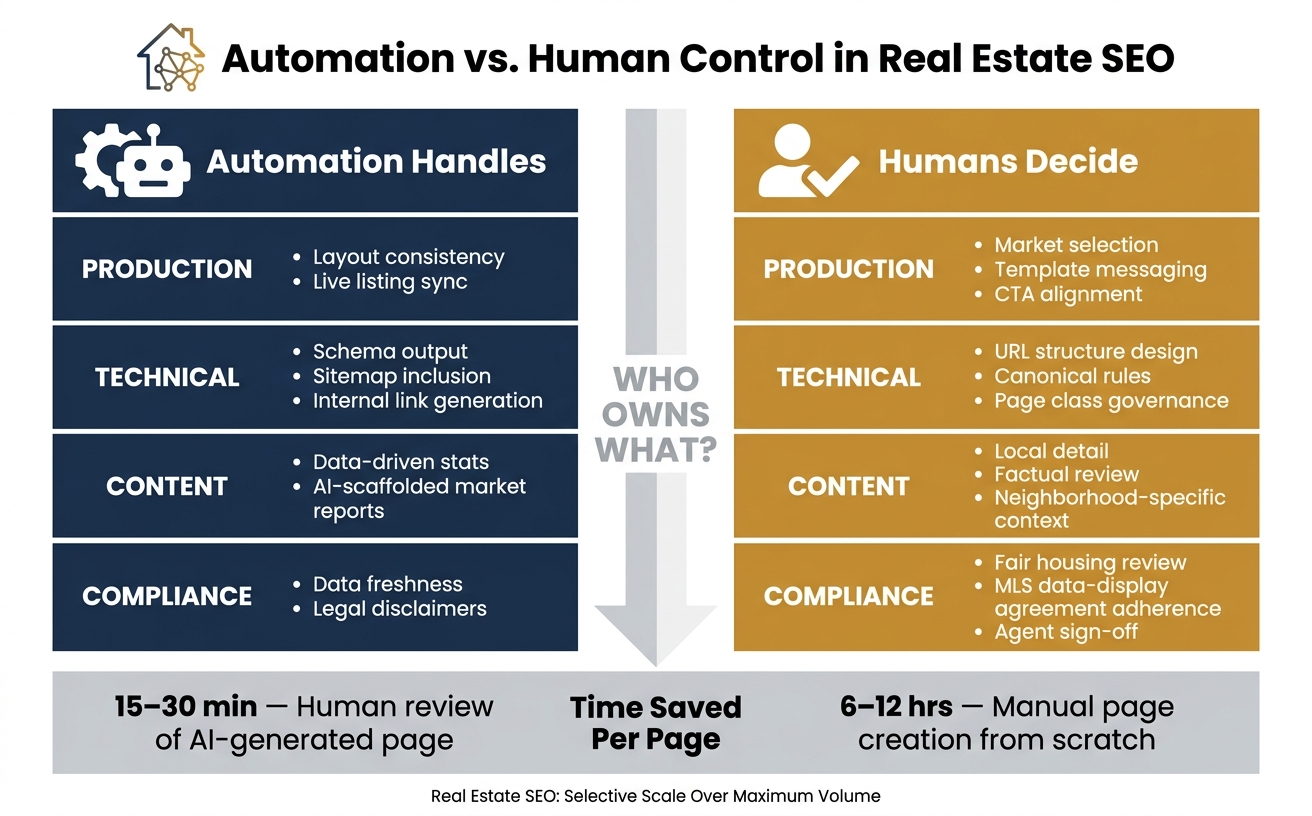
Automation vs. Human Roles in Real Estate SEO Page Networks
With the page network mapped out, the next step is simple: who owns what?
Automation handles repeatable production tasks
Once the architecture is in place, automation takes care of the repeatable work. That includes page generation from approved combinations, steady template use, live MLS sync, internal linking, schema, and sitemaps. The goal is scale that stays useful, not scale for its own sake.
Here’s where the line sits between what the system runs and what your team still owns:
| Task Category | Automation Handles | Humans Decide |
|---|---|---|
| Production | Layout consistency, live listing sync | Market selection, template messaging, CTA alignment |
| Technical | Schema output, sitemap inclusion, internal link generation | URL structure design, canonical rules, page class governance |
| Content | Data-driven stats, AI-scaffolded market reports | Local detail, factual review, neighborhood-specific context |
| Compliance | Data freshness, legal disclaimers | Fair housing review, MLS data-display agreement adherence, agent sign-off |
That split works only when people stay in charge of market and compliance calls.
Humans still control which markets to cover, what quality bar to apply, and what compliance rules to enforce
The choices that carry real business risk stay with your team. People decide which markets and page combinations are worth publishing, and that list should match your actual service area, not every ZIP code you could target. A small brokerage is usually better off with a tight set of carefully chosen neighborhood pages than with hundreds of thin pages in places it doesn’t serve [1].
People also decide what the templates should say, check AI-generated market reports for factual accuracy, and make the call on whether a weak page should be improved, merged, or removed. That matters more than it may seem. A human review of an AI-generated page usually takes 15–30 minutes, compared with 6–12 hours for manual creation [3]. For pages that can shape home-buying decisions, that human check isn’t optional.
The long-term asset here is the operating model: selective publishing, review, and governance.
CT IDX Pro+ SEO Growth Engine supports selective scale inside Real Estate 7

CT IDX Pro+ SEO Growth Engine is built around that model. It supports selective scale across cities, ZIP codes, neighborhoods, property types, bedroom counts, and price ranges. It runs as one AI-powered workflow, not split into separate AI and non-AI modes.
Live MLS data keeps pages current as inventory changes. WordPress and Elementor templates give your team control over presentation without having to touch the architecture underneath. AI-assisted market-report content comes from structured data and is reviewed before publishing [3], not treated like finished copy.
The system is built for controlled page networks. That’s why a simple multiplication example is the clearest way to show why filtering matters.
Conclusion: The Future of Real Estate SEO Is Useful Scale, Not Maximum Volume
The future of real estate SEO is useful scale, not maximum volume. Most indexed pages get zero organic traffic from Google [1]. That fact alone should change how brokerages think about scale.
The asset that lasts isn’t the number of pages on your site. It’s the operating model behind those pages.
In this case, that model has four parts: automation, live MLS data, WordPress presentation control, and human review. That’s the model SEO Growth Engine is built to support.
AI helps speed up drafting. Human review adds the local details and on-the-ground context that make a page worth visiting.
If you want to build a controlled page network that grows with your actual service area, explore how SEO Growth Engine works within CT IDX Pro+.


